

The History of Butler County Industry, 1870–1930
By Mary E. Collins | Illustrated Historical Research Pamphlet
Digitized by Historic Poplar Bluff
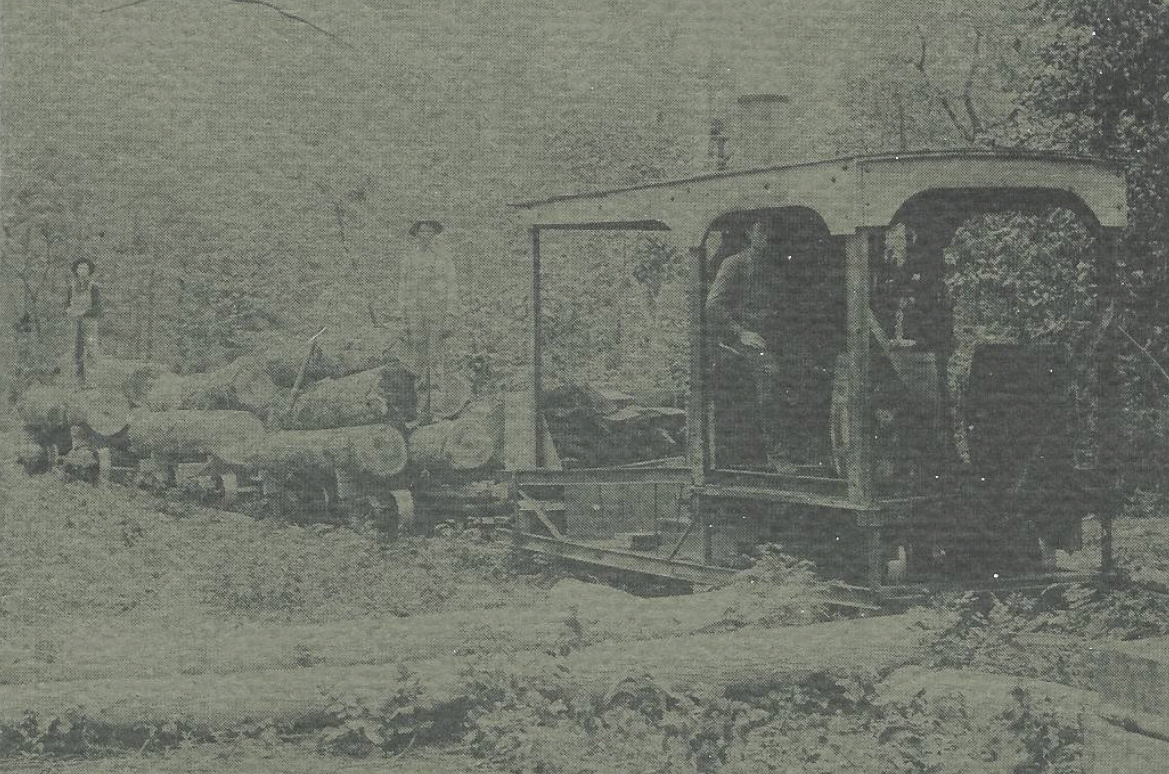
A steam log hauler with loaded timber cars at a Butler County lumber operation — cover image of the pamphlet.
Read the Booklet
Digital edition shown for on-site reading. A download link is available below.
Each page is shown to fit the reader. Use the arrows to turn the pages, or read the transcription below. Full-size scans can take a few moments to open the first time.
About This Document
An illustrated historical research pamphlet examining the businesses, industries, transportation networks, and natural resources that shaped Poplar Bluff and Butler County between 1870 and 1930. Individual sections document enterprises including the Dalton Adding Typewriter Company, Poplar Bluff Lumber and Manufacturing Company, Brooklyn Cooperage Company, J. N. Roberts Veneering Factory, and the Begley wagon and coffin factories. The publication also covers industries that declined or relocated and proposed ventures that never fully developed, with historical illustrations, photographs, statistics, and an extensive bibliography.
Speaker / Author
Mary E. Collins
Location
Poplar Bluff, Butler County, Missouri
Details
- Creator:
- Mary E. Collins
- Place created:
- Butler County, Missouri
- Format:
- Illustrated historical research pamphlet — 21 scanned pages, with archival front matter
- Document type:
- Book / Booklet
- Language:
- English
- Pages:
- 23
- Era:
- 1870–1930
Mary E. Collins wrote the pamphlet. The publication credits Jack Clark and Harry Crain as photographers, Laura Clark as artist, Richard Minetree for slide narration, Bill Pennington and Tim Mottran for scale models, Mary Vinson as project director, Robert Seifert as fiscal agent, and Viola Byrd as project secretary.
The pamphlet was produced with support from the Missouri Committee for the Humanities, the state-based arm of the National Endowment for the Humanities. It covers Butler County and Poplar Bluff, Missouri.
A Region Built on Timber, Rivers, and Rails
The booklet traces the region's early timber and lumber industries, Black River steamboat transportation, woodworking and cooperage factories, and manufacturing enterprises, along with the arrival of railroads that connected local industry to markets beyond Southeast Missouri. It closes with the businesses that declined or moved away, and the ventures that were proposed but never fully developed.
About the Date
1870–1930 is the period the booklet covers, not its publication date. References in the text to later events indicate it was prepared after 1930, but the exact date has not yet been established.
The History of Butler County Industry 1870-1930
Pamphlet written by Mary E. Collins Photographers: Jack Clark Harry Crain
Artist: Laura Clark
Slide Narration: Richard Minetree
Scale Models: Bill Pennington Tim Mottran
Administrative Staff: Project Director: Mary Vinson Fiscal Agent: Robert Seifert Project Secretary: Viola Byrd
This project supported by a grant from the Missouri Committee for the Humanities, the state-based arm of the National Endowment for the Humanities.
INTRODUCTION
Industry in Butler County began as soon as the first settlers arrived. Solomon Kittrell, a native of Kentucky, settled on Cane Creek about 1819, sunk a tan yard, erected a distillery, and established a trading post.
At an early day a mill to grind corn into meal was built by Albert Reeves at Keener Springs. James Brannum and Andrew Powers built a dam and mill at a point later known as Ball's Mill.
Most of the communities had a shoemaker who measured feet and made boots and shoes, but the settlers did their own repair work on these shoes.
Soon the settlers began planting sorghum cane to make molasses. The first cane mills were made of wood, and, when grinding the cane, they made a noise which could be heard for miles.
The real beginning of industrial development in Butler County was the advent of the railroad. The St. Louis, Iron Mountain, and Southern Railway was completed through Poplar Bluff in 1872. Saw mills and woodworking factories sprang up, and the timber, which had before been a hindrance to the clearing and development of farms, became a valuable commodity.
The development of the steamboat industry on Black River was initiated as a result of the timber boom. In addition to getting timber from the upper Black River and having it cut and rafted downstream, steamboats brought in logs, staves, and other timbers.
The years between 1872 and 1900, were the timber period of Butler County. Larger timber factories and mills and many smaller saw mills gave employment to thousands of people. Among the largest of these were the Poplar Bluff Lumber and Manufacturing Company, R.P. Liles Company, H.D. Williams Cooperage Company, Brooklyn Cooperage Company, Keystone Lumber and Land Company, J.N. Roberts Veneering Factory, and the Hargrove-Ruth Lumber Mill.
The railroad also enabled other industries to develop by providing a way to ship manufac- tured goods to market. During the first decade of the Twentieth Century, many factories were established, some by men whose descendants still live in Poplar Bluff. The largest of these was the Dalton Adding Typewriter Company, incorporated in 1903, which grew from a one-room operation into a multi-million dollar business.
Other industries which were started about this time were Jim Hogg's Whiskey Distillery, Hanna and Young Handle Factory, Oil Well Supply Company, Dalton Brick and Tile, W.B. Hays Soda Water Factory, Begley's Wagon Factory, and C.W. Tetwiler Concrete Block Plant.
By the end of 1907, Poplar Bluff boasted of having fifty-seven manufacturing plants, which employed 1,387 men, with annual payrolls of nearly $600,000.
Many of the factories in Poplar Bluff worked at increased production during World War I. Residents reported that on Armistice Day at the close of the war all the whistles on all the mills and factories in Poplar Bluff blew for a solid hour in celebration.
Most of the timber was cut out by the middle years of the 1920's, and many factories and mills closed, ending a colorful era in the history of Poplar Bluff industry.
The stories of a few representative manufacturing companies in Poplar Bluff and Butler County have been included in this booklet.
BLACK RIVER AND ITS INDUSTRIES
Poplar Bluff, similar to many other towns, grew up along the banks of its river. During the years between 1870 and 1900 rafts of logs were floated from upstream in Black River to the mills and factories in Poplar Bluff that sprang up after the coming of the railroad in 1872. Logs were also cut in Butler County and rafted down the river to mills in Arkansas.
Steamboats were used in the timber industries and were common on Black River until well after the turn of the century. Steamboats traveled on the river, bringing in logs, staves, and other timbers.
Among the first boats was the Clara I., a steamboat that sank about three miles below Poplar Bluff. The Bull of the Woods was one of the largest and earliest boats operating on Black River. It was owned by the Poplar Bluff Lumber and Manufacturing Company and was used to haul logs, lumber, and merchandise to and from all points on the river. The Belle of Carola, the Alma Jane, the Louisa, the Roy, and other stern wheel light draft boats operated successfully for years on Black River.
Some Black River boats also served as excursion boats. Two of these were the Jennie Lee and the Bernice. Excursion boats not only took passengers on sight-seeing trips, but also took hunters and fishermen on sporting excursions. Another excursion boat which visited here was the City of Doniphan. The boat arrived in Poplar Bluff in July, 1911, having come by water from Doniphan. It was a stern-wheeler, about eighty feet long, which could accommo- date one hundred passengers. A trip from Poplar Bluff south to Dan River cost fifty cents.
Poplar Bluff was the scene of steamboat building as well. Grant Boothby built two boats for Captain Amos Huff in the early years of this century, the Amos Huff and the City of Poplar Bluff, a seventy-five foot long boat with a three-foot draft.
G.W. Huff built a steamer, City of Pocahontas, at the Hargrove-Ruth lumber mill in 1906-07. The boat, one hundred feet in length, was later based in Pocahontas, Arkansas, and used as a freight and passenger carrier on the Black and Current Rivers. Captain Huff built another one hundred foot boat in Poplar Bluff in 1907-08, called the Choctaw, which was said to be the handsomest and fastest boat ever built for use on either the Black or White Rivers. He had previously built another steamboat in Poplar Bluff, the C.W. Huff.
In 1897, a pearling boom struck Black River and Butler County when Dr. J.H. Meyers of Black Rock on Black River in northern Arkansas found a fourteen grain fine luster pearl in the river. Many pearls were eventually found in Black River, some of which were sold to women as far away as London and Paris.
Even up into the Twentieth Century pearls were still occasionally found in the river. The Daily Republican of October 3, 1911, reported the discovery of an eighty-five grain, pale pink pearl in Black River just south of Poplar Bluff which sold for $1,300. On December 29, 1911, another finding was reported, a twenty grain pearl of unusual beauty, which was worth about $500.
Shells found in the Poplar Bluff area were at one time kept and shipped on steamboats to button factories. There was one of these factories in Corning, Arkansas, where a machine reemed out up to ninety buttons from one good-sized shell. The wastes of the shell were then used to pave the streets of Corning. An article in the Daily Republican on August 11, 1911, reported the opening of the Black River Pearl Button Company in Poplar Bluff.
Black River was, indeed, the scene of many activities during the early days in Poplar Bluff.
JIM HOGG'S DISTILLERY
Sometime during the early 1900's, James R. Hogg established a distillery on the family farm west of town, and manufactured "Jim Hogg's Corn Whiskey." The whiskey was sold and shipped to almost every country in the world in very unusual jugs. Mr. Hogg had a gallon, half gallon, and, at Christmas, a half-pint jug. Advertisements in the newspaper in June, 1912, offered Jim Hogg Whiskey for $2.50 per gallon. At the time he was making and selling the whiskey, the Women's Christian Temperance Union was very active in Butler County. Mr. Hogg was one of the first to be asked for donations, and was always generous with his gifts. He also served several terms as sheriff of Butler County.
Jim Hogg had come to Butler County in 1870, with his parents and grandparents. While still very young he began to help butcher stock and began to sell meat from a wagon. About 1884, he established a meat market on Broadway. Early pictures show outside displays during the winter of wild turkeys, bear meat, squirrels, rabbits, and other wild game for food, as well as life-sized bears hanging in their coats. There has never been a time since this that Poplar Bluff has been without a Hogg's Market.
J.N. ROBERTS AND COMPANY VENEERING FACTORY
Situated in the southern part of the city near the riverbank, the J.N. Roberts and Company Veneering Factory was established about 1880, with a capital investment of $25,000. Nearly every variety of timber was brought into this establishment, either floated down the river or hauled overland by team. The company used a fifty horsepower engine and employed about one hundred persons.
Their first proceeding was to take a log and put it through a steaming process. The timber was then put into machines and worked up into veneers from one-sixteenth to one-half inch in thickness.
The veneers were used for different purposes. The oak veneer was used only for the manufacture of bushel baskets. The poplar veneer was made into brush backs, furniture, trunk tops, lath, peach, strawberry, and cracker boxes. The factory could turn out between 75,000 and 100,000 strawberry boxes per day. The gum veneer was converted into sewing machine furniture and all kinds of fruit boxes and crates for shipping fruits. The walnut veneer was used for all kinds of furniture.
The maple, elm, and birch veneer were made into baskets of all descriptions, but the birch made the best quality of baskets. The basket department was separate from the rest of the factory, and employed fifty men, women, boys, and girls to turn out three hundred dozen baskets per day.
The manufactured articles were shipped to all parts of the United States at the rate of about two railroad cars per day.
BEGLEY WAGON AND COFFIN FACTORIES
In December, 1877, a young blacksmith named George Begley arrived in Poplar Bluff and opened a shop on the corner of Pine and Broadway. After a short time, he realized Poplar Bluff was a good market for wagons and buggies and started to manufacture horse drawn vehicles.
Mr. Begley's business soon outgrew its first location and a larger shop was erected on the corner of Vine and Broadway. He could make about twenty-five wagons per year.
After a few years the business outgrew these quarters, and, in the fall on 1903, a large brick building was built at a cost of about $85,000. The new factory was reputed to be the largest wagon factory in South Missouri or North Arkansas. Power was furnished by a large gasoline engine. A force of fifteen men were now able to produce about 200 wagons a year. Farm, log, and spring wagons were made.
Begley sold more than 1000 wagons in Poplar Bluff and vicinity, for as the newspaper explained in 1903, "As for the imported stuff, while it sells cheaper, the quality is not nearly so good, and wise buyers prefer the home made."
Mr. Begley, realizing the future of the undertaking business, went to an undertaking school and learned the art of embalming. With Jacob Frank furnishing the livery equipment, he established the first mortuary in Poplar Bluff, the Frank Undertaking Company, in 1879. This company is still operating as Cotrell Funeral Chapel.
Mr. Begley soon began making coffins for use in his company. In March, 1911, he began the manufacturing of coffins to sell to other companies in the building erected for the wagon factory. The wagon manufacture was continued as a secondary line, while the main business was making coffins.
[Illustration caption: A typical wagon of the period.]
POPLAR BLUFF LUMBER AND MANUFACTURING COMPANY
This company began operations in Poplar Bluff by the purchase of a small saw mill just below the depot. In the summer of 1883, they purchased sixteen acres of land in the southern portion of the city, for which they paid $1,500. On this ground a larger factory was built as well as a number of two-story frame buildings for use of their employees. The mill had a forty-horse power engine with a daily capacity for sawing 20,000 feet of lumber from a lath to a girder 50 feet long. The shingle machine could make 40,000 shingles daily.
The Poplar Bluff Lumber and Manufacturing Company owned steamboats which they used on the waters of Black River in carrying logs, lumber, and merchandise to and from all points on the river. Their boat, the Bull of the Woods, was one of the first steamers operating on Black River. They later owned the Roy, which sank at her moorings in Poplar Bluff in 1906, after several years of service.
The company used oak, ash, cypress, walnut, pine, gum, and cherry in the manufacture of lumber of all kinds, flooring, lath, shingles, and any other article of wooden manufacture which was needed.
BROOKLYN COOPERAGE COMPANY
About 1900, Lowell M. Palmer bought a large amount of swamp timber land between Black and St. Francis Rivers in Butler County, Missouri, and Clay County, Arkansas, and built a big factory in east Poplar Bluff to manufacture staves and heading. The manager of this plant was William N. Barron, a young lawyer, a native of England, who had come to Poplar Bluff about 1894. The plant was known for five or six years as the Palmer Mill. Later the business was conducted in the name of R.M. Parker, agent, and known as the Parker Plant. In January, 1910, the plant began operating as the Brooklyn Cooperage Company. By the time of Poplar Bluff's Golden Jubilee celebration in June, 1911, the Daily Republican called it "the largest barrel factory in the land."
The company employed between 750 and 1,200 men in Poplar Bluff. The Brooklyn Cooperage Company was a subsidiary of the American Sugar Refining Company of New York City. The Poplar Bluff plant manufactured slack barrel staves and heading for the use of shipping sugar from the refineries. The barrels were not assembled here, but the staves and heading were bundled and shipped to the refineries in order to lower freight expense, as the bundled stock took less space in railroad cars than assembled barrels.
Other types of staves were manufactured known as "tight barrel staves" that would hold liquid. Commonly known as whiskey barrels, these were not bundled but stacked loose in cars and shipped to distilling companies over the country. This was not a fulltime operation, as they were made from a good grade of white oak, which was not always available.
Closely associated with Mr. Barron and the Brooklyn Cooperage Company were two other projects, immensely important to the growth of Butler County. They built a standard gauge railroad from Poplar Bluff to Piggott Arkansas, used mainly to bring timber to their plant, but later used to haul other freight and passengers.
[Illustration caption: Old Sue - Butler County Railroad 1905]
This road was incorporated as the Butler County Railroad about 1904-05. When all the timber had been cut out, about 1928, it was sold to the Frisco Railroad.
The towns along the Butler County Railroad were named by William Barron. Piggott, Arkansas was named after his sister, Mrs. Sarah A. Piggott. Broseley, Missouri was named for Mrs. Barron's home town of Broseley, England. Fagus is a Latin word which means beech tree. Other Butler County towns along the railroad were Tipperary, named because the railway workers had to walk a long, long way to erect a switch; Quercus, named after the Latin term for oak; Nyssa, also named after a tree; Batesville, which grew up on the Horace Bates farm; and Spread, which died when the timber was all cut.
Mr. Barron became interested in the future development of the lands after the timber was harvested, and was instrumental in the establishment of the Inter-River Drainage District in Butler County. The result was the complete drainage of all the territory between the Black and St. Francis Rivers from the Arkansas line to the foothills to the north. This opened up a rich farming region in the county.
The Brooklyn Cooperage Company moved to South Carolina about 1927, when the timber supplies were exhausted in Butler County.
GILMAN AND REYNOLDS STAVE FACTORY
F.G. OXLEY STAVE COMPANY
H.D. WILLIAMS COOPERAGE COMPANY
In the southern part of Poplar Bluff below the railroad yards a stave factory was operated by the firm of Gilman, Sprawl, and Reynolds. In September, 1883, Mr. Sprawl sold his interest and the factory became known as the Gilman and Reynolds Stave Factory. The factory employed about seventy-five persons and made whiskey, tierce, and pork barrel staves, and shipped at least a railroad car of these staves each day.
The F.G. Oxley Stave Company was the successor to the firm of Gilman and Reynolds. Goodspeed's 1888 History of Southeast Missouri described the Oxley Stave Company, "The factory is perhaps the largest of the kind in the State, and gives employment to more men than all the other industries in the town combined. The company pays for timber and expenses over $100,000 per year."
This company later became the American Stave and Cooperage Company and then the H.D. Williams Cooperage Company, said to be the largest plant of its kind in the world. It gave employment to hundreds of men who made and shipped the products to all parts of the world.
ADEN CLAY MINE
About 1920, an unusually good grade of clay was located by Frank Aden on his farm in the Good Hope community, about five miles south of Poplar Bluff. His children, Lucy, Alva, and Flossie, were playing in the woods when they noticed that the water was white like milk. They told their father, who dug out a piece of the white clay and placed it on a fence post. The family didn't think much about it until one day when G.E. Doane drove by the farm, noticed the clay, and asked to have it assayed.
Mr. Aden augered down nine feet and found the black clay, and also some brown and some white. He leased the forty acres to Grover Dalton, J.R. Boyden, and G.E. Doane. The clay was mined and hauled by wagons to Poplar Bluff where it was shipped to different markets and used to make dishes, spark plugs, tile, and other porcelain products. The salary for the workers was $1.25 per day. The mine operated on that scale for about seven years.
Mr. Aden then leased the mine to R.T. Vanderbilt and Ira Sproat of New York, who, as salesmen, sent in the orders. Mr. Aden and his son, Alva, would ship the clay to the markets. The mine was later sold to a company from Pennsylvania.
DALTON ADDING TYPEWRITER COMPANY
One of the largest and most famous manufacturing concerns in the history of Poplar Bluff industry was the Dalton Adding Typewriter Company. A man named Hopkins in St. Louis had invented the machine and persuaded his friend, James L. Dalton, to help finance its manufacture.
Mr. Dalton had come to Poplar Bluff from Doniphan in 1885, and by the turn of the century, was manager of the large four story Wright-Dalton-Bell-Anchor Department Store, a merchandising business that grossed up to $760,000 a year, with a sales force of 125 persons and 12 delivery wagons. Mr. Dalton later stated, "One of our greatest accomplishments was the bringing into this town a solid train load of 35 cars of merchandise. The general manager of the Missouri Pacific Railroad personally made the trip with this train for a considerable part of the journey and we entered the town with green and red fire and a great demonstration."
So, as a secondary investment, Mr. Dalton helped finance the machine known as the adding typewriter. The Dalton Adding Typewriter Company was incorporated in August, 1903, with a capital of $500,000. Work began in one room of what was known as the Davidson Building on the corner of Main and Pine Streets with about twenty-five employees.
By June, 1907, the company occupied the entire Davidson Building and employed 100 men. In 1908, the Dalton Company had a payroll of nearly $10,000 per month, and had a new government contract for 125 machines. Orders were also coming in from nearly every country in the world. Mr. Dalton was forced to resign at the department store to devote his full time to the Adding Typewriter Company. Describing the machine, the Poplar Bluff newspaper, the Daily Republican reported, "The machine is truly a marvel. It adds, subtracts, multiplies, divides, figures interest, proves invoices, and performs many other mathematical calculations with such facility, speed, and accuracy as to be almost beyond belief."
In November, 1909, the capital stock was increased to $1,500,000 to enable the company to build a new factory building on the riverfront in Poplar Bluff. The new factory, built at a cost of $100,000, was dedicated February 14, 1911. One of the biggest electric signs in the state was placed on top the new factory. The sign, 250 feet long and 4 feet high, advertised the "Dalton Adding and Listing Machine Company." President Dalton made arrangements with the Iron Mountain Railroad to connect the sign with the block system and as a train pulled into the yard, the sign would light automatically.
Hours for the new Dalton Factory were 7:10 A.M. to 6 P.M. five days a week and until noon on Saturday until state legislation in about 1913-14 enacted a nine hour day. The company then began operating all day on Saturday.
As early as 1906, rumors had begun to circulate that the company was leaving Poplar Bluff. Finally, in 1914, it became necessary to move the factory to Cincinnati, Ohio, as it had grown so much that a larger location with more facilities was needed. Here the plant grew to be one of the largest in the world. On June 27, 1914, the plant ceased operation in Poplar Bluff, a great loss to the industry of our city.
HANNA AND YOUNG HANDLE FACTORY
Hanna and Young Handle Factory, located near the roundhouse in the south part of town, began business in Poplar Bluff late in 1905. Charles W. Young designed and installed all the equipment used in the factory.
Originally located in Morehouse, the factory was moved to Poplar Bluff because of the better shipping facilities, and also because the timber used in manufacturing the wooden handles was easier to get here.
OIL WELL SUPPLY COMPANY
In 1905, George R. Schweitzer, who had come to Neelyville from Chicago in 1897, became the manager of the Oil Well Supply Company in Poplar Bluff. Owned by United States Steel, the company made sucker rods for pumping oil. These were long hexagonal wood rods with steel couplings fastened to the ends.
The firm continued its progress throughout the first three decades of the Twentieth Century, its production rising constantly. New machinery was used in conjunction with new manufacturing techniques, and the sucker rods were sold all over the United States and in many foreign markets. Francis J. Schweitzer joined his father in the company about 1919.
In the late 1930's, U.S. Steel sold the Oil Well Supply Company to George R. Schweitzer, Francis J. Schweitzer, and Norman Gamblin. During World War II, scarcity of good timber and difficulties in obtaining steel, combined with advent of metal pumping rods, caused the business to be shut down.
CITY FLOUR MILLS
In the 1870's, soon after the railroad came to Poplar Bluff, J.W. Carmichael and E.N. Lovelace erected a mill on the southeast corner of Fifth and Vine Streets. The mill was originally built for grinding corn, but the owners intended to add flouring machines later. Before the work was completed, Mr. Carmichael died and the mill was sold.
The flouring department was eventually completed, but the mill was not a success until it was sold again to Hugh Smith and Sons, who made it a paying institution. The mill made three grades of flour and could produce about twenty-five barrels of flour per day.
BUTLER COUNTY STATISTICS
The industrial development of Poplar Bluff and Butler County during the early years of the Twentieth Century was demonstrated by the many factories.
The Daily Republican reported on December 10, 1903, that Poplar Bluff had, "Three railroads with a survey for two more, four big lumber companies, a sash and door factory, the largest barrel factory in the state, a handle factory, a hub factory, a spoke factory, an oil well supply factory, a pressed brick factory, an adding machine factory, a slack barrel and veneering factory, a heading factory, a cigar factory, and eighteen miles of tram railway owned by one factory."
Commodities shipped from Butler County in 1907, included: live stock- $135,426; farm crops- $3,107; mill products- $5,163; farmyard products- $42,943; forest products-$1885,180; dairy products- $28; liquor- $10,000; fish and game- $2,006; packing house products- $12,262; cotton products- $21,419; medicinal products-$371; vegetables- $129; fruit- $117; wool and mohair- $494; mine and quarry products- $1,445; junk and ice-$2,340; for a total of $2,122,430.
In 1907, Poplar Bluff had fifty-seven manufacturing plants and shipped goods valued at $2,581,053. These enterprises employed 1,387 men, their annual payrolls amounting to nearly $600,000.
During the Golden Jubilee Celebration, the newspaper reported on June 9, 1911, "Poplar Bluff boasts of having the largest barrel factory in the land, The city also produces lumber, spokes, hubs, handles, oil well sucker rods, wagons, typewriter cabinets, coffins, windows, doors, sash, patent laths, egg cases, and all kinds of fine turned work for building. Poplar Bluff manufacturing is not confined to woodworking, but car wheels and other foundry products, cigars, ice, cereals, soda water, and last and undoubtedly the greatest adding machines are made here."
INDUSTRIES THAT MIGHT HAVE BEEN
Some industries which might have been important to Poplar Bluff never quite got off the ground.
In 1909, a Poplar Bluffian, T.G. Van Sant, invented a vacuum cleaner and applied for a patent. The newspaper extolled its virtues, "The cleaner is very wonderful. It, in fact, surpasses any former cleaning device. It is compact and yet contains all the virtues of a cleaner. It can be connected to any electric light drop without danger of blowing out a fuse, for it is operated by a tenth horse power motor. It can be handled with ease by any woman without physical exertion." Mr. Van Sant planned to manufacture under the name of the Black River Company and sell the machine for $10.
Poplar Bluff might have been a rival of Detroit if another business venture had been successful. In May, 1911, an automobile built by C. and Neal Williams was scheduled to be tested. The Williams brothers invited a reporter for the Daily Republican to make the test ride with them. The paper did not report any results, but just before the trip it stated, "If everything turns out okay, this may be the beginning of the extensive manufacture of automobiles in Poplar Bluff."
If President Randall of the Commercial Club, a forerunner of the Chamber of Commerce, had been successful in 1910, tourists might have come to Poplar Bluff instead of St. Louis to see the arch. He planned to erect an arch, known as the "Gateway to Poplar Bluff," at the south end of Main Street where people passed going to and coming from the train station. The arch was to have electric lights illuminating it at night. The Daily Republican reported, "...there would be no city in this part of Missouri with such an imposing gate through which to receive the public. The proposition will be laid before the people and public subscription asked to raise money with which to erect the monument of progress."
Bibliography
Sources used in researching articles for this booklet included:
Books and Pamphlets "Come on Ladies and Gents, Ride the City of Doniphan: Fifty Cents" by Andy Collins (Historical research paper) History of Butler County by David Bruce Deem History of Southeast Missouri by Goodspeed Publishing Company Souvenir of Poplar Bluff, Missouri (1908 pamphlet printed by Walter H. Kennedy) A View of a Growing Town by Richard L. Metcalfe
Newspaper Articles
Begley Wagon and Coffin factories: Poplar Bluff Daily Republican - October 20, 1903 March 11, 1910
Black River Industries: Poplar Bluff Daily Republican - April 9, 1903 May 4, 1903 October 18, 1906 June 7, 1907 March 9, 1908 July 11, 1911 July 14, 1911 August 11, 1911 October 3, 1911 December 29, 1911
Brooklyn Cooperage Company: Poplar Bluff Daily Republican - November 11, 1902 February 23, 1905 March 17, 1908 January 13, 1910
Butler County Statistics: Poplar Bluff Daily Republican - December 10, 1903 June 18, 1908 June 9, 1911
Dalton Adding Machine Company: Poplar Bluff Daily Republican - August 29, 1903 December 8, 1906 June 4, 1907 April 16, 1908 March 24, 1909 July 13, 1909 August 16, 1909 November 17, 1090 April 12, 1910 April 19, 1910 August 20, 1910 August 27, 1910 October 21, 1910 January 30, 1911 February 14, 1911 March 17, 1914 June 10, 1914 June 27, 1914 January 12, 1926 Norwood Advertiser (Norwood, Ohio) - February 14, 1922
Industries That Might Have Been: Poplar Bluff Daily Republican - December 4, 1909 March 21, 1910 May 13, 1911
Letters and Personal Interviews
W.E. Bachus - Brooklyn Cooperage Company James Dalton - Dalton Adding Machine Company Paul Hogg - Jim Hogg's Distillery George Schweitzer - Oil Well Supply Company Lucy (Aden) Womack - Aden Clay Mine
People & Organizations Mentioned
St. Louis, Iron Mountain, And Southern Railway
transportation
Poplar Bluff Lumber And Manufacturing Company
industrial
Keystone Lumber And Land Company
industrial
Hargrove-Ruth Lumber Mill
industrial
Dalton Adding Typewriter Company
industrial
Jim Hogg's Whiskey Distillery
industrial
Hanna And Young Handle Factory
industrial
Oil Well Supply Company
industrial
Black River Pearl Button Company
industrial
Missouri Pacific Railroad
transportation
Source & Provenance
Copyright status undetermined; the original publication date has not been established. The physical copy is held in the Historic Poplar Bluff collection and the digital edition may be downloaded and used for personal research, education, and historical study. Commercial reuse requires written permission.
Download & Use
The complete digital edition is available to download for personal research, education, and historical study.
Download Full Booklet (PDF)