

An Independence Day Oration
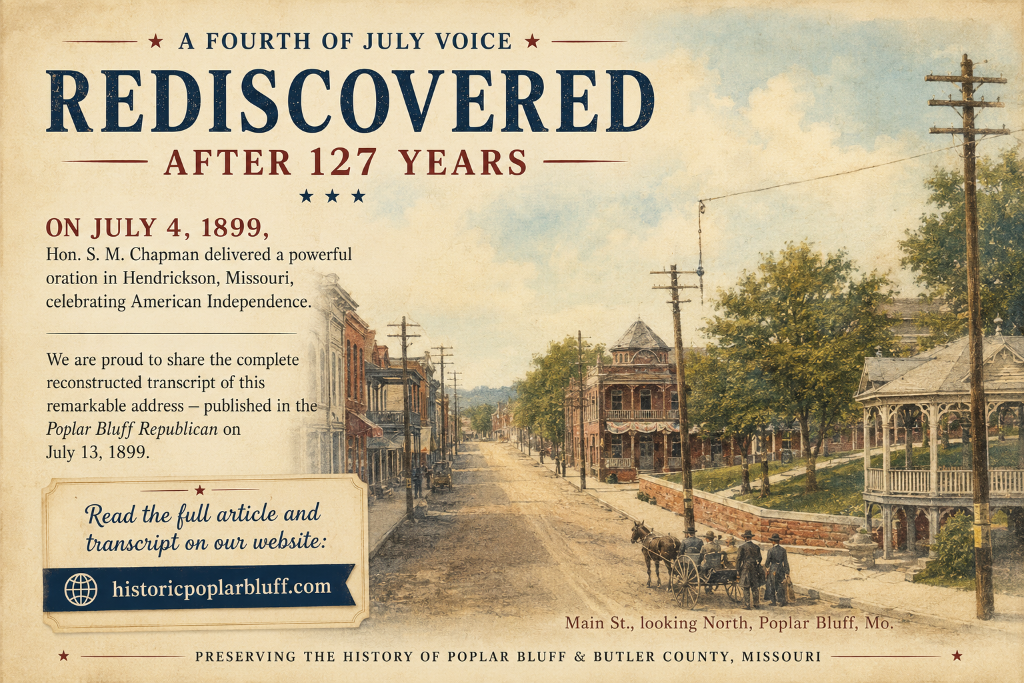
A Fourth of July Voice Rediscovered After 127 Years — Main St., looking North, Poplar Bluff, Mo.
More than 125 years ago, residents of the small Butler County community of Hendrickson gathered to celebrate Independence Day. Their featured speaker, Hon. S. M. Chapman, delivered an address reflecting upon liberty, citizenship, education, faith, national unity, and America's future as the nineteenth century drew to a close. The speech was later published in full in the Poplar Bluff Republican on July 13, 1899. Today, this remarkable address offers a glimpse into the ideals and aspirations that shaped Butler County at the turn of the twentieth century. Historic Poplar Bluff is pleased to preserve and share this historic document as part of our growing digital archive.
Speaker / Author
Hon. S. M. Chapman
Date
July 4, 1899
Location
Hendrickson, Missouri
Hon. S. M. Chapman served as the featured orator during Hendrickson's Independence Day celebration of July 4, 1899. While additional biographical research remains underway, his address demonstrates a broad knowledge of American history, classical civilization, public education, constitutional government, and the ideals of the American republic.
Although small today, Hendrickson was an important railroad community in northern Butler County during the late nineteenth century. The community was established after the railroad reached the area in 1873 and was named for Nathan Hendrickson, the original owner of the town site. A post office opened there in 1875, and the town served the surrounding farming and timber communities for generations.
When Chapman delivered this address:
- Missouri had been a state for 78 years.
- The Civil War had ended only thirty-four years earlier.
- The Spanish-American War had concluded the previous year.
- Railroads and telegraphs were rapidly transforming everyday life.
- America stood at the threshold of a new century.
These events shaped both the optimism and the patriotic themes found throughout the speech.
"Today is the Fourth of July; it is the birthday of our Nation."
"It is a day worthy of the occasion and the public gathering I see before me."
"The memories and associations that cluster around this day... will revive throughout the country."
"Freedom of conscience, freedom to worship God."
"America may well feel proud of her history, her heroes, her battles and her victories."
"This proud triumph was not purchased by the blood and treasure of any state or section, but our country in common."
"There is no north or south, but one common country."
"Mothers, teach your children that E Pluribus Unum is no idle word."
"Let us never forget that we are one people; one common country; one common glory in the past; one common hope for the future."
"...committing our country into the hands of Him who controls the destiny of Nations."
Opening Address
Mr. Chairman, Ladies and Gentlemen:
I am happy to meet you on this anniversary of American Independence. I congratulate you upon this day's return, and with feelings of more than ordinary pleasure do I join with you in its celebration. I greet you that this day was born, not only on our account, but on account of its importance to the great family of Nations, to oppressed humanity and those to whom we must yield our places in the future.
To-day is the Fourth of July; it is the birthday of our Nation; it is a grand, sublime and glorious day. It is a day filled with the memory of grand achievements; a day full of hope and promise for the future; a day for the cultivation of loved and tender memories sacred to the patriotic dead. It is a day worthy of the occasion and the public gathering I see before me; a day fraught with associations fit to be inscribed in golden letters upon our National escutcheon, worthy of being dedicated anew, sacred to Freedom, Liberty and Independence.
Such were the emotions coming with yonder rising sun to fill your hearts and mine upon the return of this eventful period. At the same time came the breathing of a grateful impulse inspiring us to return thanks to that good Providence who has so kindly preserved us in the past, for those blessings which crowd around our memories while we here celebrate the proudest event ever written upon the calendar of time.
The Declaration and Its Legacy
One hundred and twenty-three years ago to-day — a day ever to be cherished as sacred in the history of free government — our fathers published to the world that Declaration just read in your hearing, which severed the ties that bound us to Great Britain and has made our country the admiration of the world.
It cannot be that the return of this anniversary — this Sabbath day of Freedom — will ever fail to awaken in the hearts of the American people recollections full of deep feeling. I have no desire to intensify emotions born of such remembrances, but deem this to be an appropriate occasion to calmly reflect upon the past and to borrow from its teachings lessons of wisdom for our future guidance.
The memories and associations that cluster around this day, and the event it is celebrated to commemorate, will revive throughout the country, like an electric shock, a spark of those liberty-loving principles that led our fathers to spurn the pomp of England, and to barter homes adorned with social delights of cultivated life, to rear for themselves and their posterity homes amid the wilds of America, a country that to-day stands first in the great constellation of Nations as the birthplace of liberal ideas, enlightened philanthropy, an untrammeled press and free discussion. If England is in advance of us upon the solution of the social problem and modern law reform, these had their inception upon the sunset side of the Atlantic. If Prussia has advantages in her educational and military systems, America is far in advance of any other country as the garden of free thought — the home of social and religious freedom, freedom of thought, freedom of conscience, freedom to worship God.
Those germs of Freedom, the love of Liberty implanted in the bosoms of those heroic men and women who embarked upon the restless waves of the Atlantic to seek an asylum and refuge from persecution, will not expire with the present century, but will expand in growth and development until they shall animate the heart of every American from Maine to Louisiana, where there is one large enough to appreciate the value of free institutions.
The Roots of American Liberty
Free institutions belong to us, and yet it would be an error to suppose that they had their inception and birth in the American Revolution. Before there was a Washington, a Franklin, a Jay, a Henry or a Hancock, religious intolerance in Europe paved the way for American Liberty. It was at the mouth of the Humber, and with such men as Hooper, who, rather than be false to himself and renounce the God he worshipped, could, like Guatimozin, yield up his life upon a bed of burning coals calmly as a child sleeping upon roses. It was with such men, from such scenes and from such associations, sprung the noble heroes of the Revolution.
It was there, with a firm reliance upon that God who saved the Hebrew infant in the bulrush ark, that many left their native soil and the homes they loved for the only asylum then offered to free conscience — Republican Holland. Next they set sail from Amsterdam and Leyden, accompanied by song and sacred music, like the canticles intoned in the departure from Egypt, and before setting foot on the shores of Plymouth drew up that grand contract, the first charter of the Republic.
Yet more than a century elapsed between each of these great historic movements; the discovery of America and the landing of the Pilgrims; between the landing of the Pilgrims and the Declaration of Independence; and one hundred and twenty-three years ago to-day was proclaimed the independence of this country.
If the centuries of the past were to invite judgment, the century which formed the Republic in America and spread revolution over Europe; the century which extinguished the faggot and destroyed the rack, might well exclaim before the tribunal of history: "If I did not invent modern art like the fifteenth century; if I did not mould the modern conscience like the sixteenth century; if I did not train modern reason like the seventeenth century — I have done more than all these; I have pioneered the way and engraven the landmarks to a higher and grander civilization, upon which to found and perpetuate a government based upon equal rights and the just claims of a free and enlightened people."
Progress and the New Century
If the present century has not been the theater of revolution, it has been an age of intellectual and scientific progress. It has been reserved for us, in the closing years of the nineteenth century, to live in the crowning era of the world's highest attainments. It has been the epoch and era of railroads and steamship navigation, telegraphy and electrical utility.
It is now seventy-eight years since Missouri became a member of this great family of states, and I am proud to know that she is well-nigh to the front, where she will soon maintain a leading rank with the proudest of her sister states. These years have marked an epoch in the world's history of highest development which has left its impress upon every object that greets the eye. We read its traces in the rural walk and the crowded city; in the gilded mansion and the humble cabin of the mountaineer. It is seen in the busy railroad and the flying steamer; it visits our homes, and sits down the familiar companion of our fireside, and lights up the chamber of our thoughts with intelligence from London and Paris and Germany, communicated by the electric messenger in advance of time.
These years have been busy belting the earth with railroads; in reaching out her magic lines from town to town, from city to city, and from continent to continent, until at last, as if to mock the imagination, she has not only brought Europe and America within speaking distance, but has rendered our connection so close and intimate with all great commercial powers of the earth, that not a hostile gun is fired upon the distant banks of the Nile, the Po or the Danube, or the farthest islands of the sea, whose reverberations are not felt along our whole Atlantic coast and whose echo is not heard through the entire valley of the Mississippi.
Science has bared her pale and thoughtful face, while with her magic fingers she has plucked the lightning from the mountain cloud, held in check its fury and taught it submission to the wants of men. Science has not only tamed the elements, but has domesticated the power of steam, which at her bidding moves its ponderous train with a dizzying velocity; making the firm earth to tremble beneath her hurried tread. It plows our fields, cultivates our gardens and gathers our harvests. Our splendid system of railroads and steamship navigation; of telegraphy and submarine cables, by which the man in New York, Boston, Philadelphia, St. Louis and Chicago talks with his neighbor in London and Liverpool, in Paris and Germany, are all the growth and product of the present century. If these are the fruits of the present century, what may we not reasonably anticipate for our children and those who are to claim our places in the centuries to come?
While we do not say that the world is indebted to us for all this progress, we are entitled to the lion's share, and America is to-day the proud theater, the beacon light and guiding star to which Europe and Asia are turning with anxiety and inquiring solicitude. Already has the spirit of our institutions diffused new life, not only into France, Spain and other far states of monarchical Europe, but China, Hindostan and the far-off islands of the sea are being lit up with the approaching dawn of a higher civilization by the teaching of our example.
To-day we unfurl to the gaze of an admiring world the emblem of Liberty — the proud banner of the Stars and Stripes. That proud emblem at the distance of another century, when other generations shall have come and gone; when it shall wave over the ashes of all who hear me; when the mold shall have gathered upon your memories and mine — will, I doubt not, be hailed with the same feelings of patriotic pride by our children and posterity that to-day fill your hearts and mine.
The Foundations of the Republic
Our fathers faithfully labored to maintain this government upon its present basis, and although the burden of the Revolution had fallen heavily upon them, they hailed the day with pride that severed their allegiance to the parent country, securing them in future from the tyranny of England.
For a long time the inhabitants of the colonies yielded a cheerful obedience to the claims of the mother country, and would have so continued had not the haughty spirit of England made her exactions intolerable. Had her exactions been less, instead of celebrating this Sabbath of American Freedom, we might have been among the most devoted subjects of England's Island Queen, and joined the grand chorus in singing to her praise. There was not so much in the burdens imposed as in the character of her demands and the mode of the exactions. There was a vital principle involved, recognized by the colonies as not only unjust but as paving the way to reduce them from the allegiance of freemen to serfs and to vassalage; and although her haughty monarch, George the III., was eloquently admonished that his policy would, if he continued, alienate forever the heart of the American people, obstinate to the last he continued, until the pent-up storms had culminated in a whirlwind of revolution, shaking from his crown its brightest jewel, and America was Free.
This lovely land of Liberty, these benign institutions, the dear purchase of our fathers, are ours; ours to enjoy, ours to perpetuate. Our fathers admonish us from the past; posterity calls us from the bosom of the future; hope turns to us with anxious solicitude, all entreating us by an appeal to the past, the present and the future, by what we are and all we hope to become, to transmit, unimpaired, this valuable inheritance to our children.
May the day never come when Americans can look with indifference and disregard upon the noble mission of that little band of patriots who, one hundred and twenty-three years ago to-day, in the city of Philadelphia, pledged to each other and the world their lives, their fortunes and their sacred honor to sustain the Declaration that gave birth to this Republic. What nobler deed, what sublimer act has history recorded, than that of fifty-six patriots, on that occasion, not only renouncing the Divine right of kings, but in deciding Freedom to a continent? Let us to-day renew that pledge in all its parts; it is the charter of our Freedom; it is the bulwark of our Independence, and the guardian of our Liberties. May its sublime and patriotic teachings sink deep into our every heart. May its principles become our watchword, and the guiding star of our children now, to-day and forever.
This government, the grand nucleus of all free governments, is still in its infancy. Should we attempt to estimate its future by its record in the past, we would be lost in the contemplation. As well might we attempt to count the glittering gems that are nightly seen in heaven's broad arch above us. Our motto and our march is Onward. From a few feeble colonies, with a population of less than three millions, we have grown into forty-five states and five territories, with a population of more than seventy millions.
The Westward March and the Fate of the Indian
The wilderness of the west has given place to the onward march of civilization, while the prairies and woodlands of Illinois, Indiana, Iowa, Missouri, Arkansas, Texas and the further west have been made to bud and blossom as the rose, until luxurious fields and cultivated gardens have taken the place of the hunting grounds of the Indian, the history of whose race is too sad to dwell upon, and yet that history is familiar to some who hear me. Hardly a century has passed since his fires were brightly burning in this country, since he fished in our rivers and hunted in our forests; since the smoke from his rude wigwam proudly curled within sight of the very spot upon which we are now assembled.
At the approach of the white man, at the shock of civilization, they fade away. Like the melancholy winds, like the withered leaves of autumn, they pass mournfully by us, and they are gone forever; and whether we dwell with pride upon their savage virtues, or shrink with horror at the thought of their atrocities, there is much in their history not only to move our pity, but to enlist and to warm our sympathies. This country was their home and birthplace. The white man came among them and was kindly and hospitably treated until he betrayed their confidence, and it has been well said: "If they forgave not an injury, neither did they forget a kindness; if their vengeance was terrible, their fidelity and generosity were unconquerable also."
But where are they now? Once brave and fearless, they were numbered by millions, and possessed this country from the Atlantic to the Pacific. Now, faint, few and feeble, they have been driven to the further west, where as a distinct race of people they will soon be known only in the history and traditions of the past, a faithful admonition that the strong trample down the weak — that intelligence is power.
Our sons, leaving the older and more densely populated states, have taken their way westward; and not only have they crossed to the sunset side of the Mississippi, but westward and onward with the star of empire they have scaled the Rocky Mountains, and, for the last fifty years, have been pouring themselves along at the golden gates of the Pacific; and there proud states, California, Oregon, Washington and Nevada, have grown up, where churches, towns and cities have sprung into existence as if in obedience to the fiat of Him who speaks and it is done. And to-day, from the frozen regions of Alaska, the land of ice and snow, to the sunny clime of the Gulf of Mexico; from the broad Atlantic to the great inland seas; from the Father of Waters to the distant shores of California and Oregon — one government and one flag give assurance and protection to seventy millions of people speaking a common language; the government is one of their own choice; the flag, the emblem of Liberty, and the language that of Shakespeare and Milton, our own loved English.
Education as the Guardian of Liberty
Such is now our common birthright. How shall we preserve and perpetuate this grand heritage, our present form of government? It has been reared upon the altar of intelligence and virtue, and can be maintained only by a system of mental and moral training reaching all who share in its administration, holding up to the mind the light of intelligence and to the heart the standard of duty. Let our youth be properly educated, morally and intellectually, and their future will be safe. Open to them the paths of proper mental and moral culture, and no tyrant, foreign or domestic, will long trespass upon their rights or trample upon their liberties. If they grow up without these advantages, as they assume the duties of citizenship and the administration of the government, those political clouds, now dimly remembered in the dreamy shadows of the past, may become darker and more ominous.
Universal intelligence and a high standard of public morals are of the first importance to any country, particularly in our form of government, where society receives its complexion, the law its sanction, public morals its stamp of approval, the church its impress, and the Christian religion its sacred reverence from citizens in every walk of life.
While this is true to some extent in the history of other countries, it is especially so with us, where the humblest citizen wields an influence in the administration of the government and exercises a voice in the enactment and execution of those laws by which his duties to the government are defined and his rights as a citizen are maintained and defended, and must so continue while our present form of government remains unchanged.
A Nation of intelligent, educated people, men and women, not only know how to respect the rights of others, but to maintain and defend their own. Of all the European states, Prussia was first to recognize this great fact, and of her brilliant triumph it is unnecessary for me to speak, as it has long since been a matter of familiar interest to every student of history. In 1806, when Napoleon had overrun that country; when her royal capital had been stripped of everything thought worthy of being transported to Paris; when taxed beyond her ability to pay — she conceived and practiced the grand idea that the poverty of a people is no reason for abridging the public provision for general education, but is just cause for enlarging her revenue for public education, that she might render her people more intelligent and self-reliant, and the children of that generation, in 1870, were thundering with cannon at the gates of Paris, demanding that the wrongs of their fathers be righted, and that appeal was answered, and restitution followed.
This country, in imitation of her noble example, has made most liberal provision for implanting the germs of true mental and moral development in the heads and hearts of those who are to become her future citizens, subjects and rulers; and our elevation in little more than a century, from a few feeble colonies to a position in the great family of Nations, where she shines forth as a star of the first magnitude, is largely due to this policy. While other countries were seeking to acquire a golden record in the triumphs of war and the march of victorious armies, America has been content to maintain the Liberty and prosperity of her people, embalmed in the arts of peace and cultivated intelligence. Cultivated intelligence and a higher civilization will dissolve the armies of war and convert her soldiery into laborers, mechanics and husbandmen, busy in promoting the peaceful vocation of social life.
National Pride and Victory
America may well feel proud of her history, her heroes, her battles and her victories; her heroes as brave as Leonidas, and victories as proudly won as those of Salamis, of Marathon, or Thermopylæ. No people, no country, no army have a grander and sublimer record. Our victories at Santiago and Manila, and the acts of heroism there displayed, are worthy of any age, of any people or country.
What prouder triumph has history recorded than the event we are here to commemorate? May we never forget that this proud triumph was not purchased with the blood and treasure of any state or section, but our country in common. It is not due to north or south, east or west, that this bright page in our Nation's history has been written, but side by side her sons braved the dangers of the battle-field; side by side they won victory after victory; and side by side they gathered trophies and won laurels upon the same fields of battle.
In that conflict no one was asked whether he had first opened his eyes at Camden or at Bunker Hill; whether he had been cradled upon the rugged hills of New England or rocked upon the plains of South Carolina. They were enlisted in a common cause, and on more than one occasion the patriot from the north and the hero from the south faced the cannon's mouth together; together, sword in hand, they met a hostile and invading army, and in the defense of the birthright of freemen poured out upon their country's altar life's priceless crimson streams, like rain, to mingle in a common pool.
If there was nothing else to bind together the American people, these are ties which no thoughtful person will willingly sever. To what section would belong the ashes of the patriotic dead? The urn that contains their sacred dust, like the memory of their noble deeds, is the common legacy of all.
Reconciliation: The Blue and the Gray
Much as we may regret, deeply as we may deplore the war with Spain, in Cuba and the Philippines, it has served one lasting good of which we to-day are justly proud, and which nothing else could have so effectively accomplished during the lifetime of the present generation. It has obliterated all sectional prejudice and hate from the hearts of all our people, until in sentiment there is no north or south, but one common country, peopled with the children of the fathers of the Revolution. All the actors in that drama have gone to their reward. Other conflicts may rage, other wars may devastate, they are at rest. No more will the clash of arms, the battle's strife or the cannon's roar, disturb their repose. They are sleeping beneath the quiet of the stars, careless alike of the conflicts of the past or the turmoils of the future. Let the patriots and the heroes sleep, while we cherish in fond remembrance, in loved and tender memories, their grand achievements.
Within the memories of some who hear me dark and angry clouds overhung our country, threatening to plunge it into the vortex of ruin. All looked forward to the termination of that fratricidal conflict with anxious solicitude. That storm has passed; its fury has abated; all is again peace and quiet, an additional guarantee of the stability of this government. Thirty-four years more, the lifetime of a generation, have been recorded in history since the closing scenes in that melancholy drama. The leaders of that conflict have gone to their reward. Lincoln, Grant, Hancock and Logan on the one side, and Davis, Lee, Jackson and Jo. Johnston on the other, have been consigned to the tomb. Like the heroes of Bennington, Plattsburg and Wyoming, they have joined their fathers in the vast beyond — in the land of silence.
All the traces of the late fratricidal conflict have been obliterated and their memories well-nigh forgotten. Thirty-four years of uninterrupted prosperity have brought the hostile sections into more intimate relations; we have learned to know each other better, and have cultivated warmer ties of friendship, until the Blue and the Gray have joined hands in a devoted and loved reunion. I am proud that it is so; the best interests of all and of our country demand it. The Gray and the Blue have sympathies in common; they sprung from the same ancestry; they worship at a common altar; they speak the same language, adore the same God and kneel at the same shrine of devotion. Let us obliterate and efface from our memories forever all sectional and party prejudices, and join in friendly greetings, irrespective of former affiliations. This policy has made us one people in the past and can alone preserve us one common glory in the future.
If we adopt an opposite policy, our country will need no historian. The history of Greece and Rome, Venice and Genoa, will be our history. Like the ancient Republics that have gone before us, we too may sink beneath the surges of time, with no voice to record our memory but that which proclaims our folly — like Rome she flourished, and like Rome she perished — and our history and our epitaph will be written. Let us bury in forgetfulness and consign to oblivion all hostility and bitterness of feeling engendered in the past, and, in the sublime language of Curfew, "Cover the embers and put out the light."
A Tribute to Women and Mothers
My Fellow-Citizens: It is good for us to be here upon this day's return. It is good for the women to be here, for from whom must spring the future men of this Republic, her on whom its future most depends. I am proud to see so many ladies who have been pleased to honor us, to testify by her presence the interest she feels in this day's association. So many eyes sparkling with the inherent graces that adorn her pathway will not only add cheer to the occasion, but her magic presence, like an electric shock, will warm our hearts, elevate our thoughts and exalt the natural current of our feelings.
Ladies, mothers, women, in the name of our common country, in the interest of all that is pure, loving and good, I welcome you here. I believe in woman; I believe in her capability, in her power and influence for good. The labors of woman may be circumscribed and narrow; she may be hidden from the public gaze and withdrawn from the daily bustle of the busy world; her footsteps may seldom mark the public thoroughfares and crowded highways, yet she wields a powerful and controlling influence in every circle of society and every walk of life. That influence may be silent and unseen, but, like the majestic river sweeping noiselessly onward, it is mighty and resistless, and could I win from heaven one gift, most of all faithful and devoted to my country, it would be the power to inspire the heart of every mother in the land with the noble consciousness that she is indeed a priestess at the altar of her country's future. How pure, noble and sublime the mission of the mother. How impressed upon my own heart are those early lessons coming from that sacred source that first taught me the meaning of this day, and although death's freezing touch has sealed those loving lips, her teaching and admonition will live sacredly embalmed in my memory while reason holds her empire unthroned.
Mothers, teach your children that E Pluribus Unum is no idle word; that their country's motto should be cherished and sacred. Teach it to them as they climb upon your knee, as you fondly press them to your bosom at their morning vows and their evening's devotion. Do this and a crown brighter than the laurels of victorious conquerors will be your reward.
Conclusion
In conclusion, my Fellow-Citizens, let us ever honor this day as first in the year of our political calendar, as a day of congratulations, and with hearts swelling beyond all party limits, let us never forget that we are one people; one common country; one common glory in the past; one common hope for the future; and as we leave this place to again mingle in the busy scenes of active life, may we, with hearts filled with gratitude and devotion, commit our country into the hands of Him who controls the destiny of Nations. Do this, and far off will be the day when the light of a single star will be dimmed or blotted from our National standard. Do this, and they who, at the distance of other centuries, may stand here to celebrate this day, will have reason to exult and exclaim as we do to-day:
Here dwells their country, honored, proud and free, Prospered beyond all other lands, the home of Liberty.
— End of Oration —
This address is remarkable not only for its patriotic spirit, but for the historical moment in which it was delivered.
Speaking only one year after the Spanish-American War and little more than three decades after the Civil War, Chapman repeatedly emphasized reconciliation, national unity, and shared citizenship. He viewed public education, moral character, and religious liberty as essential foundations of the American republic.
His repeated references to Providence reflect the language commonly found in civic Independence Day addresses of the late nineteenth century and remind us how deeply intertwined faith, gratitude, and public life were in many communities of that era.
Whether readers agree with every sentiment expressed, the speech remains a valuable historical record of how one Butler County community understood the meaning of Independence Day in 1899.
Source & Provenance
Source Citation
Publication: Poplar Bluff Republican
Date: July 13, 1899
Page: 1
Author: Hon. S. M. Chapman
Location: Hendrickson, Missouri