Learning from Other Communities
By Historic Poplar Bluff
One of the unexpected joys of building Historic Poplar Bluff has been discovering how much there is to learn from other communities that have invested in preserving their own history.
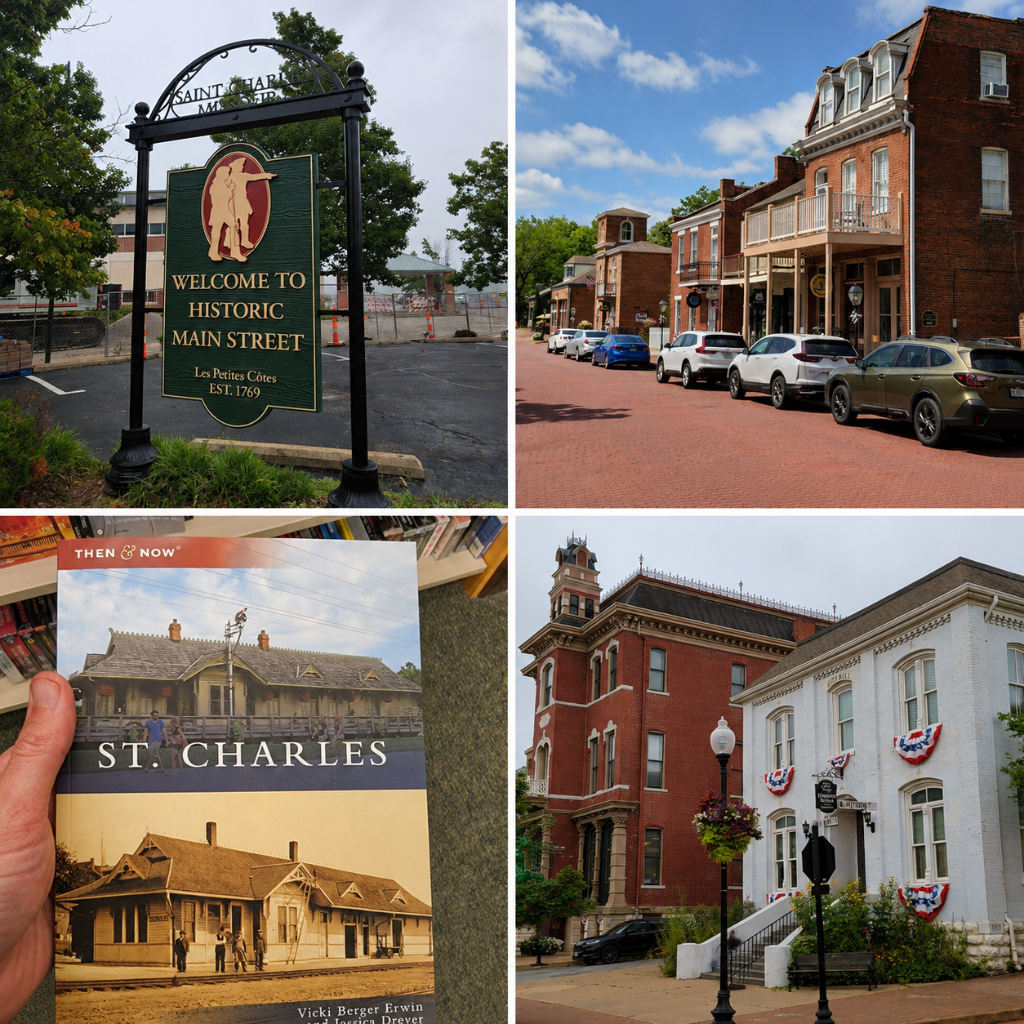
This past weekend, our family spent some time exploring Historic St. Charles, Missouri. Like many visitors, we admired the restored buildings, brick streets, museums, locally owned shops, and the countless reminders that history is still woven into everyday life. We found ourselves reading historic markers, browsing bookstores, collecting postcards, and paying attention not only to what had been preserved, but also to how those stories were being shared with visitors.
One thing that especially caught our attention was learning more about the Main Street Approach™, a nationally recognized preservation-based framework that has helped guide St. Charles for many years. Rather than focusing solely on restoring historic buildings, the approach encourages communities to strengthen their downtowns through thoughtful design, economic vitality, promotion, and community organization. It's a reminder that preservation isn't simply about protecting the past—it's also about helping people experience it in meaningful ways today.
Interestingly, Poplar Bluff's Grow Our Downtown group is working toward implementing this same framework, adapted to the character and scale of our own downtown. While our community is very different from St. Charles, it was encouraging to see a model that recognizes history as an asset rather than an obstacle to progress.
Of course, Poplar Bluff is not St. Charles, and we wouldn't expect it to be. Their historic district contains many more surviving nineteenth-century buildings and has benefited from decades of preservation efforts. Our history has followed a different path. Many of the buildings that once defined downtown have been altered or lost, leaving much of our story scattered across newspapers, city directories, family photographs, postcards, courthouse records, and memories that become harder to recover with each passing generation.
That realization reminded us why Historic Poplar Bluff exists.
When we began this project, we weren't thinking about writing books, building searchable archives, or creating digital research tools. We simply didn't want to see another photograph disappear into a forgotten box or another family story fade away because no one had taken the time to record it. One small project led to another, and before long we found ourselves spending evenings reading century-old newspapers, identifying people in photographs, indexing city directories, and asking questions that rarely have simple answers.
Visits like this also remind us that preservation doesn't happen all at once. Every museum began with someone saving an object. Every archive started with someone collecting records. Every historic district exists because generations of people made hundreds of small decisions to preserve something instead of letting it disappear. That perspective is encouraging, especially when working on a project that often feels much larger than the time and resources available to it.
We don't know exactly where Historic Poplar Bluff will be five or ten years from now. It remains a small family effort, built around evenings, weekends, and whatever time can be found between work, family, and everyday responsibilities. Some ideas will undoubtedly remain just ideas. Others may slowly become reality. That's simply part of the journey.
What we do know is that every newspaper we digitize, every photograph we identify, every historic site we document, and every story someone chooses to share adds one more piece to a record that didn't exist before. Even if the project never becomes anything more than a carefully maintained archive built by a handful of people, we hope it will make it just a little easier for someone in the future to discover a family member, understand an old building, or reconnect with a forgotten part of Poplar Bluff's story.
We returned home with a notebook full of ideas—not because we hope Poplar Bluff becomes another St. Charles, but because every historic community has something to teach us. Our goal has never been to recreate another town. It has simply been to better understand and preserve the one we already call home.