

History is more than photographs, buildings, and dates.
Sometimes it is a conversation.
One of the greatest privileges of preserving local history is discovering that the people who walked these streets before us were not so different from ourselves. They celebrated victories, worried about the future, debated the direction of their community, and hoped the next generation would inherit something even better than they had known.
Historic newspapers preserve far more than names and events. They preserve personalities, opinions, humor, and conviction. They allow us to hear the voices of those who lived the history we now study.
In this ongoing Voices from the Past series, we revisit editorials, speeches, letters, and newspaper columns that continue to speak across generations.
Our fourth installment brings us to the pages of the Weekly Citizen-Democrat, where one editor answered a question that still finds its way into conversations more than a century later.
"Is Poplar Bluff dying?"
June 18, 1903
The summer of 1903 brought uncertainty to Poplar Bluff.
The Iron Mountain Railroad had announced changes that would relocate freight division operations from Poplar Bluff to Hoxie, Arkansas, with freight terminals moving to Hoxie and Piedmont. In a railroad town, such news naturally caused concern. Businesses wondered what it would mean. Citizens speculated about the future. Rumors spread quickly.
The editor described the atmosphere plainly.
There was "a great deal of talk and a great amount of speculation."
People wanted answers.
Would this be the beginning of the city's decline?
Would more businesses leave?
What would happen next?
Rather than simply reporting those concerns, the newspaper chose to answer them.
And Now, The Voice from the Past
From the Weekly Citizen-Democrat — June 18, 1903
(Presented with light formatting for readability while preserving the original wording and tone as closely as possible.)
"What Next?"
The removal of the freight division from Poplar Bluff to Hoxie, and the changing of the crews so that the freight terminals are now at Piedmont and Hoxie instead of Poplar Bluff, has created a great deal of talk and a great amount of speculation by our people.
What does the changing of the division signify? Why was it done? What is to be the sequence, and where is the axe to fall next time, are questions every day asked, and the answers are as diverse as they are numerous.
The editor then reminds readers that Poplar Bluff's future rests upon far more than a single railroad decision.
Poplar Bluff is a self-supporting city if there be one in the country. The country adjacent is yet heavily timbered to the south and east, and the land everywhere is fertile and responds promptly to intelligent cultivation.
Moreover, the climate is particularly well adapted to the raising of all grains, grasses, vegetables and fruits that are successfully and profitably grown in the temperate zone.
Still further let us reiterate what we have many times stated, that Poplar Bluff's geographical position is such as to make retrogression a matter of utter impossibility.
The editor acknowledges that people have repeatedly predicted the city's downfall.
Then comes perhaps the most memorable passage in the entire editorial.
The reason for making this statement... is that we hear a few people decrying the city. They insist it's doom is near at hand. A maelstrom is coming and we are to be swallowed commercially. A tidal wave will next engulf us, the passenger division will fold its tent, metaphorically speaking, and then the people of Poplar Bluff will have nothing to do but hang their harp on the willows and sigh!
Then, with unmistakable confidence, he responds.
"Oh, dear."
"Well, Poplar Bluff isn't dead."
"It isn't going to collapse this week."
"It isn't going to be sent to the pawn shop and traded off for a spavined mule."
"Poplar Bluff is alive and in quite good health, thank you."
The editorial continues by reminding readers that life goes on.
Business remains active.
Crops are good.
Water is receding from the swamps.
The city is healthy.
Then comes another unforgettable comparison.
"Poplar Bluff dying? Fie! It cannot die."
Did you ever watch a pig weed grow?
Cut it off and up she bobs.
Pull it out and the root takes the soil wherever thrown, burn it and some of the seeds always fall in fertile spots!
To a modern reader, the image is humorous.
To readers in 1903, it was instantly understandable.
Poplar Bluff, the editor argued, simply refused to stay down.
He continued:
True we have had obstacles to overcome as a city.
Think of those great fires which fairly paralyzed our people for a brief period.
It looked as if our manufacturing plants were to be completely and permanently wiped out.
They weren't.
They have come back to us bigger, and better than ever.
The editorial closes by turning adversity into encouragement.
A little thing like the removal of a freight division is good for our growth.
It puts us on our mettle.
It causes us to think and act and to study concertedly, as a people, in behalf of the best interests of our city.
And finally...
"Let us therefore no longer cry any more over split milk, for none has been spilled!"
Looking Back with 123 Years of Hindsight
One of history's greatest gifts is perspective.
The editor who wrote those words could not know what the next century would bring.
He would never see automobiles replace horse-drawn wagons.
He would never witness two World Wars, the Great Depression, commercial aviation, interstate highways, or the countless changes that would reshape American life.
Yet history allows us to ask a remarkable question.
Was he right?
The answer is not as simple as saying yes or no.
Poplar Bluff certainly faced additional challenges in the decades that followed. Industries changed. Transportation evolved. Businesses came and went. New concerns replaced old ones.
But the city did not disappear.
Federal census records show continued growth during the early twentieth century, while locally compiled directory records reveal an even larger community extending beyond the official city limits. Those figures measured different things — one counted the incorporated city, while another attempted to describe the broader Poplar Bluff community — but together they illustrate a city that continued to develop rather than vanish.
The railroad changes that inspired such anxiety in 1903 became just one chapter in a much longer story.
Every Generation Asks the Same Question
Perhaps the most striking part of this editorial is not its prediction.
It is its familiarity.
Read it without the dates, and it could almost be mistaken for a modern conversation.
Communities still ask:
- Will jobs leave?
- Will businesses survive?
- Has the town seen its best days?
- What does the future hold?
Every generation inherits its own challenges.
Every generation wonders whether change signals decline or simply another turning point.
History does not promise that every concern is unfounded.
Nor does it promise that every setback will end happily.
It simply reminds us that communities are rarely defined by a single headline.
They are shaped over generations by ordinary people who continue investing in their hometown, even during seasons of uncertainty.
Why This Editorial Still Matters
More than 123 years later, this editorial remains valuable for reasons its author may never have imagined.
It reminds us that history is not only found in brick buildings, faded photographs, or census tables.
It is also found in conversations.
In opinions.
In disagreements.
In hopes.
In fears.
And in the determination of people who believed their community was worth defending.
Whether one agrees with every conclusion the editor reached is almost beside the point.
His words preserve something far more important.
They preserve the confidence, humor, resilience, and civic pride of a generation that refused to believe a single setback could define the future of Poplar Bluff.
Today, those voices still have something to say.
Editor's Note
This article is part of Voices from the Past, an ongoing Historic Poplar Bluff series exploring editorials, speeches, letters, and other historical writings that continue to speak across generations. Portions of the original June 18, 1903 editorial have been lightly formatted for readability while preserving the original wording, spelling, tone, and intent whenever possible from the surviving newspaper images.
Photos
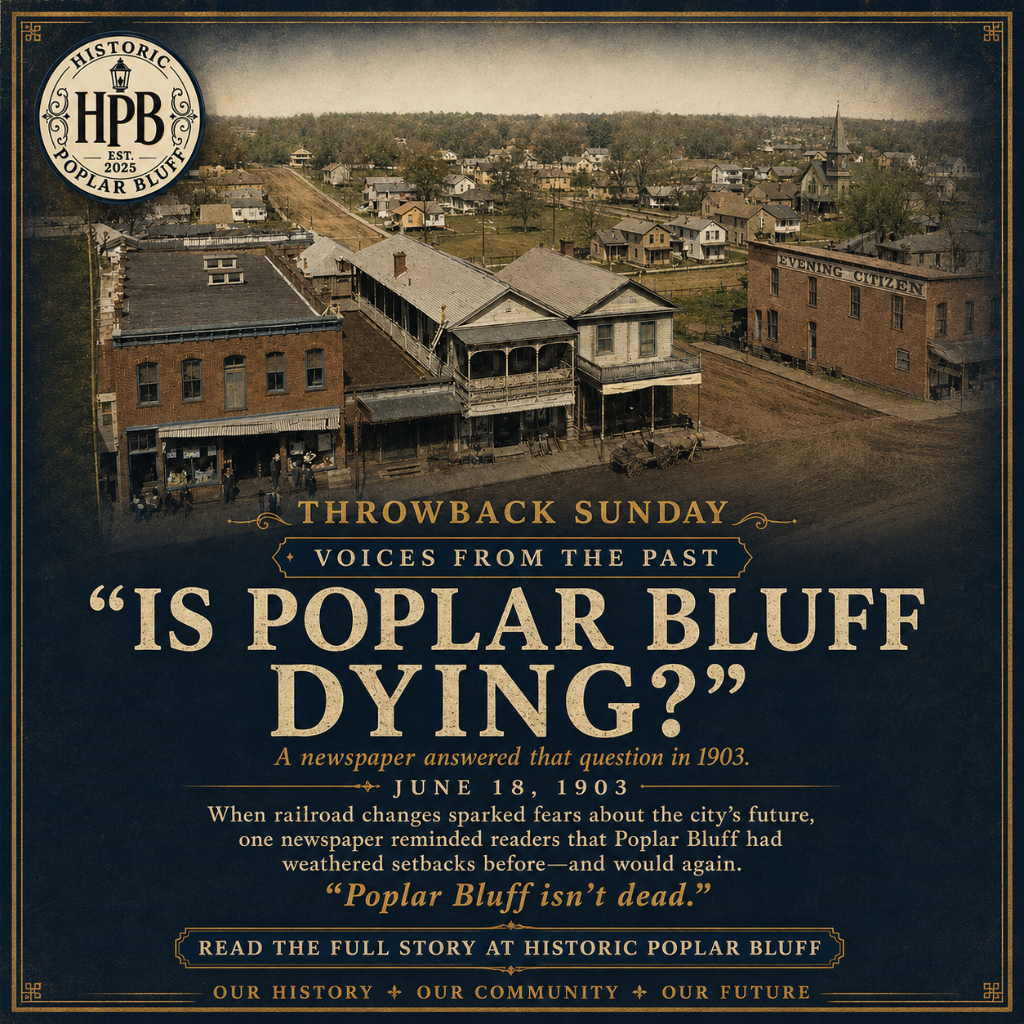
Voices from the Past — Part IV: "Is Poplar Bluff Dying?" from the Weekly Citizen-Democrat, June 18, 1903.
Source Attribution
Primary Source
Weekly Citizen-Democrat (Poplar Bluff, Missouri), June 18, 1903.
Accessed through: Surviving newspaper images in the Historic Poplar Bluff archive
Voices from the Past is an ongoing Historic Poplar Bluff series exploring editorials, speeches, letters, and other historical writings that continue to speak across generations. Rather than simply retelling history, these features allow the people of earlier generations to speak in their own words while providing historical context for modern readers.
View all articles