


Image courtesy of Poplar Bluff Republican Holiday Supplement, December 8, 1898
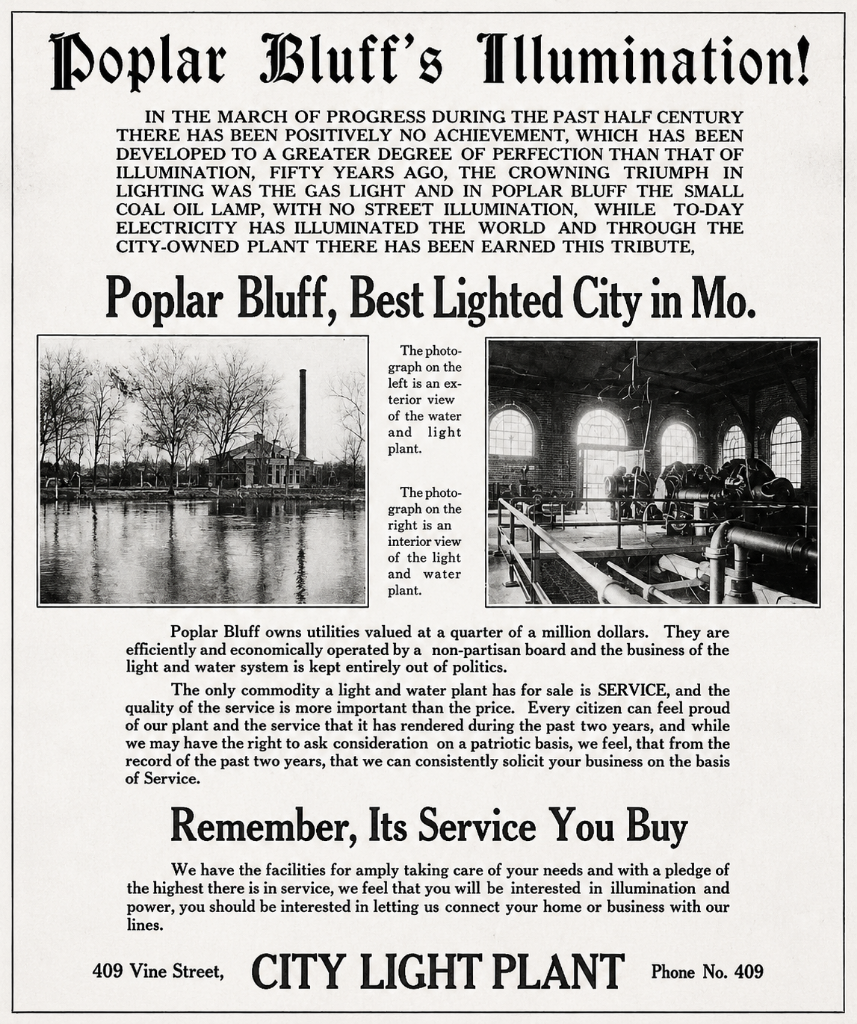
City Light & Water Works Building
City Light & Water Works Building
Poplar Bluff's electric light utility — born as a private company organized in 1896 by S. S. Hartzell, and transformed into a city-owned municipal plant by 1917 that helped earn Poplar Bluff the title 'Best Lighted City in Missouri.'
Did You Know?
Poplar Bluff's electric utility began as a private company in 1896, but the push to make it city-owned in 1915 was so controversial that businessman James L. Dalton publicly campaigned against it over fears of higher taxes. Just four years later, the city proudly advertised itself as the 'Best Lighted City in Missouri.'
The Story
The City Light & Water Works Building housed one of Poplar Bluff's most important early infrastructure projects — the story of how the city brought electric power to its streets, businesses, and homes across more than two decades of growth and debate.
The Private Beginnings (1896–1898)
The utility began as the Poplar Bluff Light and Power Company, organized in the fall of 1896 by electrical expert S. S. Hartzell.
Described in the December 8, 1898 Poplar Bluff Republican Holiday Supplement as "a most important factor in the commercial and industrial interests of the city's commonwealth," the facility was considered one of the best-equipped electric light and power establishments in all of Southeast Missouri.
The plant operated a 200-horsepower engine with a maximum capacity of 2,000 incandescent lights and 100 arc lights — serving local businesses, offices, and private residences while distributing arc lighting throughout the city. The facility's machinery, dynamos, and electrical equipment were sourced from leading manufacturers across the United States, and the plant maintained on-site repair capabilities including a screw-cutting engine, lathes, and a full complement of tools.
The building itself was described as a "handsome commodious structure" with a galvanized roof, purpose-built for the plant's operations. The article noted that only "skilled and experienced hands" were employed in all departments.
At a time when many communities still relied on oil lamps and gas lighting, Poplar Bluff's fully operational electric utility was a striking indicator of the city's modernization and commercial ambition.
A Controversial Push Toward Municipal Ownership (1914–1915)
By the 1910s, Poplar Bluff was growing rapidly, and city leaders believed municipal ownership of the utility offered greater control of the city's future. Not everyone agreed.
One of the most prominent opponents was businessman James L. Dalton, of the Wright-Dalton-Bell Anchor Department Store. In September 1915, Dalton publicly outlined his concerns, focusing primarily on financial risk — warning that construction costs could lead to increased taxation and questioning whether the city should enter the utility business at all.
The debate sparked open public discussion, with residents such as George B. Wheeler responding in print. It reflected larger conversations occurring throughout the United States during the Progressive Era over the benefits and risks of municipal ownership of utilities.
Building the Municipal Plant (1915–1917)
Despite the controversy, plans moved forward. By late 1915, contractor A. W. Greer secured the contract for construction of the new plant building, reportedly valued at more than $13,000.
Throughout 1916, newspapers documented the project's progress: shipments of copper wire, deliveries of electrical machinery, installation of poles and street lighting, and placement of generating equipment. One article noted that more than three hundred electric light standards would eventually be placed throughout the city.
By February 1917, steam tests were being conducted and final installations completed. In April 1917, the municipal light plant was officially accepted by city representatives and became the property of the City of Poplar Bluff.
"Best Lighted City in Missouri" (1919)
Only two years later, the contentious debates of 1915 had given way to civic pride. A March 1919 advertisement in the Daily American Republic proudly proclaimed Poplar Bluff the "Best Lighted City in Missouri," describing the city's utility — then valued at a quarter of a million dollars and operated from 409 Vine Street — as one of its greatest achievements.
What had begun as a controversial proposal had evolved into a symbol of progress and modernization.
Later Years
The facility continued to house the city's water works operations, serving Poplar Bluff's growing municipal infrastructure needs. In 1986, the building was repurposed when the Poplar Bluff Serenity Group moved into the former City Light and Water facility.
For the full account of the municipal plant debate and construction, see the related story "From Controversy to Civic Pride: The Story of Poplar Bluff's Municipal Light Plant."
Known Details
- Private company organized: Fall 1896 by S. S. Hartzell
- Municipal plant accepted by city: April 1917
- Plant building contract: A. W. Greer, valued at $13,000+
- Address (1919): 409 Vine Street
- Mentioned in: Poplar Bluff Republican Holiday Supplement (Dec 8, 1898); Daily American Republic (March 27, 1919)
What's There Now
The building later housed the city's water works and community organizations including the Poplar Bluff Serenity Group starting in 1986.
People Connected to This Site
Businesses Connected to This Site
Poplar Bluff Light And Power Company
Active 1890s
Original private owner and operator of the electric utility at this site at City Light & Water Works Building Notable event: Company Organized (Fall 1896) — The Poplar Bluff Light and Power Company was organized by S. S. Hartzell as a private electric utility, operating a 200-horsepower engine with capacity for 2,000 incandescent lights and 100 arc lights. Notable event: Featured in Poplar Bluff Republican Holiday Supplement (December 8, 1898) — The facility was described as 'a most important factor in the commercial and industrial interests of the city's commonwealth' and one of the best-equipped electric light and power establishments in Southeast Missouri.
Wright-Dalton-Bell Anchor Department Store
Active 1890s
Indirectly associated through its proprietor James L. Dalton, who publicly opposed municipal ownership of the utility at City Light & Water Works Building Notable event: Public Opposition to Municipal Ownership (September 1915) — James L. Dalton of the Wright-Dalton-Bell Anchor Department Store publicly campaigned against municipal ownership of the utility, warning of increased taxation and financial risk to the city.
Poplar Bluff Serenity Group
Active 1890s
Later occupant of the former City Light and Water Works building starting in 1986 at City Light & Water Works Building Notable event: Moved into Building (1986) — The Poplar Bluff Serenity Group moved into the former City Light and Water facility, repurposing the historic building for community use.
Related Stories
City Directory Listings
This address appears in the following historic city directory listings.
Possibly Connected People
These connections were automatically identified by AI from the site's historical text and have not yet been verified. They may be inaccurate or incomplete. They are shown for research purposes and will be updated as they are reviewed by our archivists.
James L. DaltonUnverified
LLM identified as "notable public opponent of municipal ownership (indirect relationship via public debate)" — "One of the most prominent opponents was businessman James L. Dalton, of the Wright-Dalton-Bell Anchor Department Store. In September 1915, Dalton publicly outlined his concerns, focusing primarily on financial risk."
Asa GreerUnverified
LLM identified as "contractor / builder" — "By late 1915, contractor A. W. Greer secured the contract for construction of the new plant building, reportedly valued at more than $13,000."
Possibly Connected Businesses
These connections were automatically identified by AI from the site's historical text and have not yet been verified. They may be inaccurate or incomplete. They are shown for research purposes and will be updated as they are reviewed by our archivists.
Quick Facts
Era
1890s
Year Built
1896
Area
Downtown
Know Something About This Site?
Share your stories, photos, memories, or help us correct information about City Light & Water Works Building.