
Contents
In March 1919, a full-page advertisement celebrated Poplar Bluff as the "Best Lighted City in Missouri."
The claim reflected more than civic pride. It represented the successful completion of a project that only a few years earlier had divided public opinion and sparked debate among some of the city's leading citizens.
Today, little remains of that controversy in public memory. Yet newspaper accounts from 1915 through 1919 reveal a fascinating story of ambition, progress, and the challenges of building modern infrastructure in a growing Missouri city.
A City on the Verge of Change
By the early twentieth century, electricity was transforming American life.
Electric lighting was replacing gas lamps. Businesses increasingly depended on electric power. Communities that invested in modern utilities were often viewed as progressive and forward-looking.
Poplar Bluff was growing rapidly during this period. New businesses, new industries, and an expanding population created increasing demand for reliable electric service.
City leaders believed municipal ownership offered a path toward greater control of the city's future.
Not everyone agreed.
James L. Dalton Voices Opposition
One of the most prominent opponents of the proposed municipal light plant was businessman James L. Dalton.
Dalton was widely known throughout Poplar Bluff. Before entering larger commercial ventures, he operated an early hardware and general merchandise business. He later partnered with the Wright family in the Wright-Dalton enterprise, which eventually evolved into the Wright-Dalton-Bell Anchor Department Store at Main and Poplar Streets.
The W.D.B.A. Store became one of downtown Poplar Bluff's most recognizable commercial landmarks, occupying a substantial four-story building and serving generations of local shoppers.
In September 1915, Dalton publicly outlined his concerns regarding the proposed municipal light plant.
His arguments focused primarily on financial risk.
Dalton warned that construction costs could lead to increased taxation. He questioned whether the city should enter the utility business and argued that citizens might ultimately bear the burden if the project failed to perform as expected.
He also expressed concern that future improvements and upgrades could require additional expenditures long after the initial construction was completed.
From Dalton's perspective, the issue was not opposition to progress itself but concern over the financial responsibilities being assumed by local taxpayers.
A Community Debate
Dalton's position sparked public discussion.
Newspaper coverage from September 1915 shows citizens openly debating the merits of municipal ownership. George B. Wheeler, another local resident, responded in print and argued that the issue deserved fair and open consideration from all sides.
Supporters believed the city should have the ability to provide its own electric service and reduce dependence on private utility interests.
Opponents questioned whether government ownership would actually deliver lower costs or better service.
The debate reflected larger conversations occurring throughout the United States during the Progressive Era, as communities weighed the benefits and risks of municipal ownership of utilities.
Construction Begins
Despite the controversy, plans moved forward.
By late 1915, contracts were being awarded for the construction of the new municipal light plant.
Newspaper reports announced that contractor A. W. Greer had secured the contract for construction of the building, which was reportedly valued at more than $13,000.
As construction progressed through 1916, local newspapers regularly updated citizens on the project's status.
Reports documented:
- Arrival of copper wire shipments
- Delivery of electrical machinery
- Installation of poles and street lighting infrastructure
- Placement of generating equipment
- Construction of the plant building itself
One article noted that more than three hundred electric light standards would eventually be placed throughout the city, dramatically expanding public lighting.
The scale of the project demonstrated that city leaders viewed the plant as an investment in Poplar Bluff's future rather than a simple utility improvement.
Nearing Completion
By February 1917, newspapers reported that the plant was approaching operational readiness.
Steam tests were being conducted, electrical systems were being inspected, and workers were completing final installations throughout the city.
Citizens could see the results taking shape around them as wiring expanded and infrastructure connected homes and businesses to the new system.
The long-discussed project was becoming a reality.
The City Takes Ownership
In April 1917, newspapers announced that the municipal light plant had officially been accepted by city representatives and was now the property of the City of Poplar Bluff.
The transition marked the culmination of years of planning, debate, financing, and construction.
While disagreements had existed during the planning phase, the city now faced the practical challenge of operating and maintaining its new utility system.
The plant would soon become an important component of daily life in Poplar Bluff.
"Best Lighted City in Missouri"
Only two years later, local advertisements painted a dramatically different picture from the contentious debates of 1915.
A March 1919 advertisement proudly proclaimed:
"Poplar Bluff, Best Lighted City in Missouri."
The advertisement described the city's utility system as one of its greatest achievements and celebrated the role municipal ownership had played in improving service.
Whether every citizen agreed with that assessment is impossible to know, but it demonstrates how quickly the project became a source of civic pride.
What had begun as a controversial proposal had evolved into a symbol of progress and modernization.
Looking Back
The story of Poplar Bluff's municipal light plant reminds us that many of the improvements we now take for granted were once subjects of passionate public debate.
Citizens, business leaders, elected officials, and taxpayers all had opinions about the city's future.
Some saw opportunity. Others saw risk. Both perspectives were part of the process that shaped modern Poplar Bluff.
Today, more than a century later, those newspaper accounts offer a fascinating glimpse into a community deciding what kind of future it wanted to build—and then finding a way to build it.
Sources
- Weekly Citizen Democrat, July 10, 1914
- The Daily Republican, September 13, 1915
- The Daily Republican, December 20, 1915
- Weekly Citizen Democrat, May 11, 1916
- Poplar Bluff Republican, December 21, 1916
- Poplar Bluff Republican, February 22, 1917
- Poplar Bluff Republican, April 19, 1917
- Daily American Republic, March 27, 1919
Photos
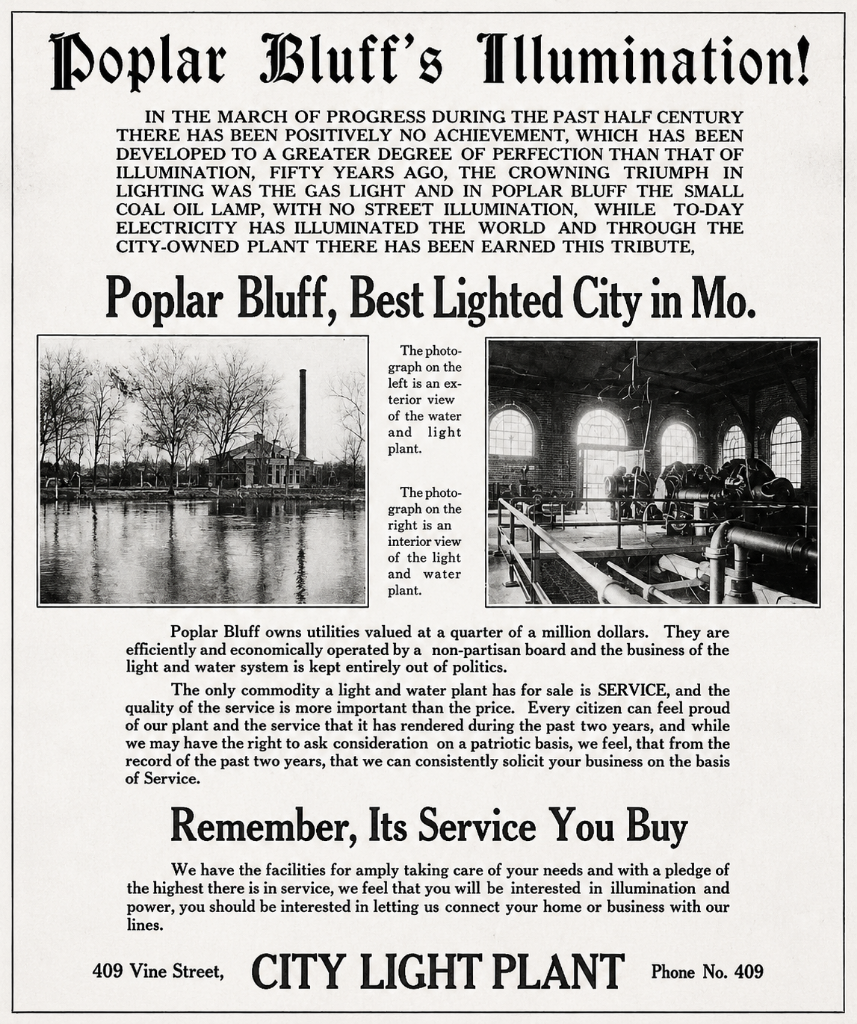
A 1919 newspaper advertisement celebrating the Poplar Bluff municipal light plant

The City Light & Water Works building along the riverfront, with crowds gathered on the lawn

Front page of The Daily Republican from September 13, 1915, outlining James L. Dalton's opposition to the light plant
Historic Poplar Bluff
Story Contributor
Source:
Compiled from multiple newspaper sources including the Weekly Citizen Democrat, The Daily Republican, Poplar Bluff Republican, and Daily American Republic, 1914–1919.
Related Historic Site

Related Business
These connections were automatically identified by AI from the story text and have not yet been verified. They may be inaccurate or incomplete. They are shown for research purposes and will be updated as they are reviewed by our archivists.
Possibly Connected People
Asa GreerUnverified
LLM identified as "contractor who secured the contract for construction of the municipal light plant building" — "Newspaper reports announced that contractor A. W. Greer had secured the contract for construction of the building, which was reportedly valued at more than $13,000."
GEOR WheelerUnverified
LLM identified as "local resident who publicly responded in support of fair consideration of the municipal light plant debate" — "George B. Wheeler, another local resident, responded in print and argued that the issue deserved fair and open consideration from all sides."
James L. DaltonUnverified
Chairman of the Board, Wright-Dalton-Bell-Anchor Store Co.
LLM identified as "prominent opponent of the municipal light plant proposal, businessman" — "One of the most prominent opponents of the proposed municipal light plant was businessman James L. Dalton."
Possibly Connected Businesses
Daily American RepublicUnverified
1950s
LLM identified as "historical newspaper source cited in the story" — "Daily American Republic, March 27, 1919"
Poplar Bluff RepublicanUnverified
1890s
LLM identified as "historical newspaper source cited in the story" — "Poplar Bluff Republican, December 21, 1916"
The Daily RepublicanUnverified
1910s
LLM identified as "historical newspaper source cited in the story" — "The Daily Republican, September 13, 1915"
Weekly Citizen-DemocratUnverified
1910-1930
LLM identified as "historical newspaper source cited in the story" — "Weekly Citizen Democrat, July 10, 1914"
Wright-Dalton-Bell Anchor Department StoreUnverified
1890s
LLM identified as "commercial landmark associated with James L. Dalton, evolved from earlier business partnerships" — "He later partnered with the Wright family in the Wright-Dalton enterprise, which eventually evolved into the Wright-Dalton-Bell Anchor Department Store at Main and Poplar Streets."