
Contents
623 South Fifth Street | Poplar Bluff, Missouri
From the Railroads to Poplar Bluff
When William Allen Holcomb came to Poplar Bluff in 1896, the city was growing as a railroad center and commercial hub for southeastern Missouri. The expansion of rail transportation, lumber production, construction, and agriculture created an increasing demand for skilled machinists and industrial services.
Holcomb brought experience from the railroad industry. Born March 29, 1861, in Greenbush, New York, he had worked for eastern railroads before making his way west. A later account of his life also recalled his employment with the Chicago & Alton Railroad.
According to newspaper retrospectives, Holcomb brought a small machine shop to Poplar Bluff when he arrived. What began as a relatively modest operation eventually developed into one of the city's established industrial businesses.
The enterprise was known at different times as the Poplar Bluff Foundry and Machine Shops, Poplar Bluff Foundry and Machine Works, and Holcomb Foundry & Machine Works.
Its work served the practical needs of a growing community. Factories, mills, contractors, farmers, and municipalities all depended upon machinery, castings, and skilled repair services to keep their operations running.
Establishing the Holcomb Works
By the early twentieth century, Holcomb had become an established figure in Poplar Bluff's industrial and civic life.
On January 28, 1909, the Poplar Bluff Republican reported that Holcomb had purchased the interest of his business partner, Robert Breuer Sr., in the Poplar Bluff Foundry and Machine Shops. The transaction made Holcomb the sole proprietor.
The newspaper also identified him as a Second Ward city councilman, demonstrating that his involvement in Poplar Bluff extended beyond his own business.
By 1914, a city directory advertisement documented W. A. Holcomb's foundry and machine works at 623 South Fifth Street, an address that would remain associated with the business for decades.
The foundry represented an important part of the city's industrial infrastructure. Its services helped maintain and supply the equipment upon which other businesses and public improvements depended.
Holcomb also participated in municipal affairs, serving on the Poplar Bluff City Council and, at another time, the Board of Public Works.
His business interests extended into construction as well. Through the Service Construction Company, associated with the Holcomb family and E. C. Thomas, he was connected with road and infrastructure development in the region.
Later newspaper accounts credited the construction enterprise with work involving Highway 67, bridges, an overpass, and other public improvements. These retrospective accounts demonstrate the breadth of the family's involvement, although the precise responsibility for individual projects deserves further documentation.
The Tornado of May 9, 1927
On May 9, 1927, one of the most destructive tornadoes in Missouri history swept through Poplar Bluff, devastating neighborhoods, businesses, and industrial properties.
The Holcomb foundry on South Fifth Street was among the buildings severely damaged.
The following day's Daily American Republic described the works as practically a total wreck.
For an established manufacturing business, the destruction represented more than the loss of a building. Machinery, workspace, and the ability to serve other businesses were all affected at a time when the entire community faced the difficult work of recovery.
Yet Holcomb moved quickly toward rebuilding.
On May 13, only four days after the tornado, the newspaper reported that the Holcomb plant would be reconstructed. The earliest announcement described plans for a one-story replacement.
Those plans soon developed into something more substantial.
Rebuilding on South Fifth Street
On June 29, 1927, the Daily American Republic reported that construction was beginning on a new Holcomb building.
The plans called for a two-story reinforced-concrete main structure measuring approximately 60 by 80 feet, together with a one-story rear extension measuring 30 by 60 feet.
The contractor was identified as Monolith Builders Company of Kansas City.
The new building represented a considerable investment in the continued operation of the foundry and in Poplar Bluff's industrial future.
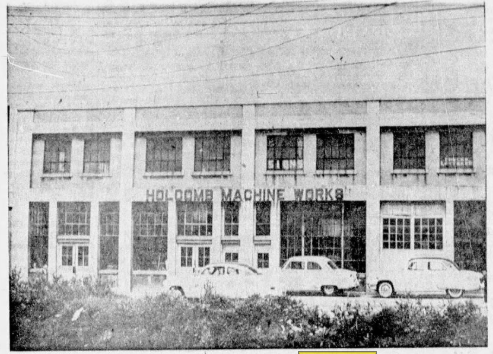
Contemporary photographs of the rebuilt plant show a broad, two-story industrial facade, tall window openings, and the name HOLCOMB MACHINE WORKS prominently displayed across the front.
Rather than abandoning the damaged location, Holcomb continued the enterprise on South Fifth Street.
The rebuilding of the foundry was part of a much larger transformation occurring throughout Poplar Bluff in the months following the tornado, as businesses and property owners repaired, replaced, and modernized damaged structures.
By the first anniversary of the disaster, the Holcomb works was once again advertising its services.
A Foundry Serving a Growing Region
A May 9, 1928 advertisement provides an unusually detailed picture of the company's operations following reconstruction.
Holcomb Foundry & Machine Works offered brass and gray-iron castings, manhole and catch-basin components, welding, forging, sheet-metal work, and machinery repairs.
Its services also included work on steam engines, farm machinery, and industrial equipment, along with mill supplies.
These offerings reveal a business whose customers likely included a broad range of local industries, contractors, agricultural operations, and municipal departments.
In an era when mechanical equipment was frequently repaired, modified, or manufactured locally, a foundry and machine works could perform an essential role in the regional economy.
The Holcomb operation was part of that practical industrial network, providing both manufactured components and the skilled labor necessary to keep machinery functioning.
Beyond the Foundry: Family and Community
William Allen Holcomb's life in Poplar Bluff was closely connected with his family and the community he had adopted.
He married Kittie Quackenbush on June 3, 1885. The couple eventually made Poplar Bluff their longtime home and raised a family whose members also became associated with the city's business life.
Their children included Winfield, Frank, Kittie Reed, and Hester Richmond.
A June 9, 1949 article in the Weekly Citizen Democrat, marking the couple's sixty-fourth wedding anniversary, reflected upon their long marriage and the growth of Poplar Bluff during their years in the community.
The account also recalled Holcomb's railroad background, his arrival in the city, and the development of his business interests.
By then, William and Kittie Holcomb had witnessed more than half a century of change, including the expansion of the city's railroads and industries, the devastation of the 1927 tornado, and the rebuilding that followed.
Kittie died on July 4, 1951.
William Allen Holcomb died March 1, 1952, at the age of 90. His obituary remembered him as a retired foundry owner and construction company official who had spent 57 years in Poplar Bluff.
A Second Generation: Frank Hoysardt Holcomb
The story of Holcomb Machine Works continued through William's son, Frank Hoysardt Holcomb.
Born September 19, 1890, in Bloomington, Illinois, Frank grew up in Poplar Bluff and graduated from Poplar Bluff High School in 1909.
He later attended the University of Missouri's School of Engineering and pursued a career in electrical and railroad work.
From 1913 to 1920, he served as chief electrician for the Wabash Railroad in Decatur, Illinois.
Frank married Marguerite Ballard on July 10, 1914.
His technical background and experience in railroad operations prepared him for involvement in the family's industrial enterprise.
William retired in 1940, and Frank subsequently directed the business.
Under Frank's leadership, the company continued operating at the South Fifth Street location, maintaining its role in Poplar Bluff's industrial and commercial community.
A December 31, 1954 feature in the Daily American Republic described the company's heavy-hardware and industrial supply operations.
Photographs accompanying that feature documented the building and provided a valuable visual record of the business in its later years.
Frank Hoysardt Holcomb died March 3, 1957, at the age of 66. His obituary identified him as the owner of Holcomb Machine Works and recalled his nearly lifelong connection to Poplar Bluff.
With his passing, another chapter in the family's industrial history came to a close.
The company's subsequent ownership, continued operations, and eventual closure have not yet been fully established through the records examined for this article.
A Building That Remains
One of the most interesting aspects of the Holcomb story is that the building constructed following the 1927 tornado remains standing on South Fifth Street.
The structure provides a tangible connection to the city's reconstruction era and to a business that served Poplar Bluff for generations.
The newspaper descriptions of the 1927 rebuilding project, together with later photographs, help establish its historical identity.
Although the precise extent of surviving original architectural material requires additional investigation, the building's continued presence makes the Holcomb story more than an account preserved in newspaper clippings.
It is a reminder of the industrial enterprises that once supported the city's growth and of the determination of local business owners to rebuild after one of Poplar Bluff's greatest disasters.
Remembering the Holcomb Legacy
William Allen Holcomb arrived in Poplar Bluff with railroad experience and a small machine shop. Over the following decades, his enterprise grew into an established foundry and industrial business.
His work extended beyond manufacturing into public service, construction, and community development.
When the tornado of 1927 destroyed the original plant, the business was rebuilt. When William retired, his son Frank continued the family enterprise.
The surviving building at 623 South Fifth Street is one of the remaining physical reminders of that history.
The Holcomb story is not simply about a foundry or a building. It is about the people, industries, and determination that helped shape Poplar Bluff during a period of remarkable change.
Historical Sources
- Poplar Bluff Republican, January 28, 1909 — W. A. Holcomb purchases Robert Breuer Sr.'s interest.
- Poplar Bluff City Directory, 1914 — Foundry advertisement and South Fifth Street address.
- Daily American Republic, May 10 and May 13, 1927 — Tornado destruction and rebuilding announcement.
- Daily American Republic, June 29, 1927 — New building construction.
- Daily American Republic, May 9, 1928 — Rebuilt foundry advertisement.
- Weekly Citizen Democrat, June 9, 1949 — William and Kittie Holcomb wedding anniversary.
- Daily American Republic, March 1, 1952 — William Allen Holcomb obituary.
- Daily American Republic, December 31, 1954 — Holcomb business feature and photographs.
- Daily American Republic, March 4, 1957 — Frank Hoysardt Holcomb obituary.
- Poplar Bluff city directories, 1914 and 1949.
Historic Poplar Bluff — Research and historical preservation.
Photos

Holcomb Foundry & Machine Works — the article header graphic, built around a 1950s photograph of the plant. The parchment layout, lettering, and framing are modern design, not period printing.

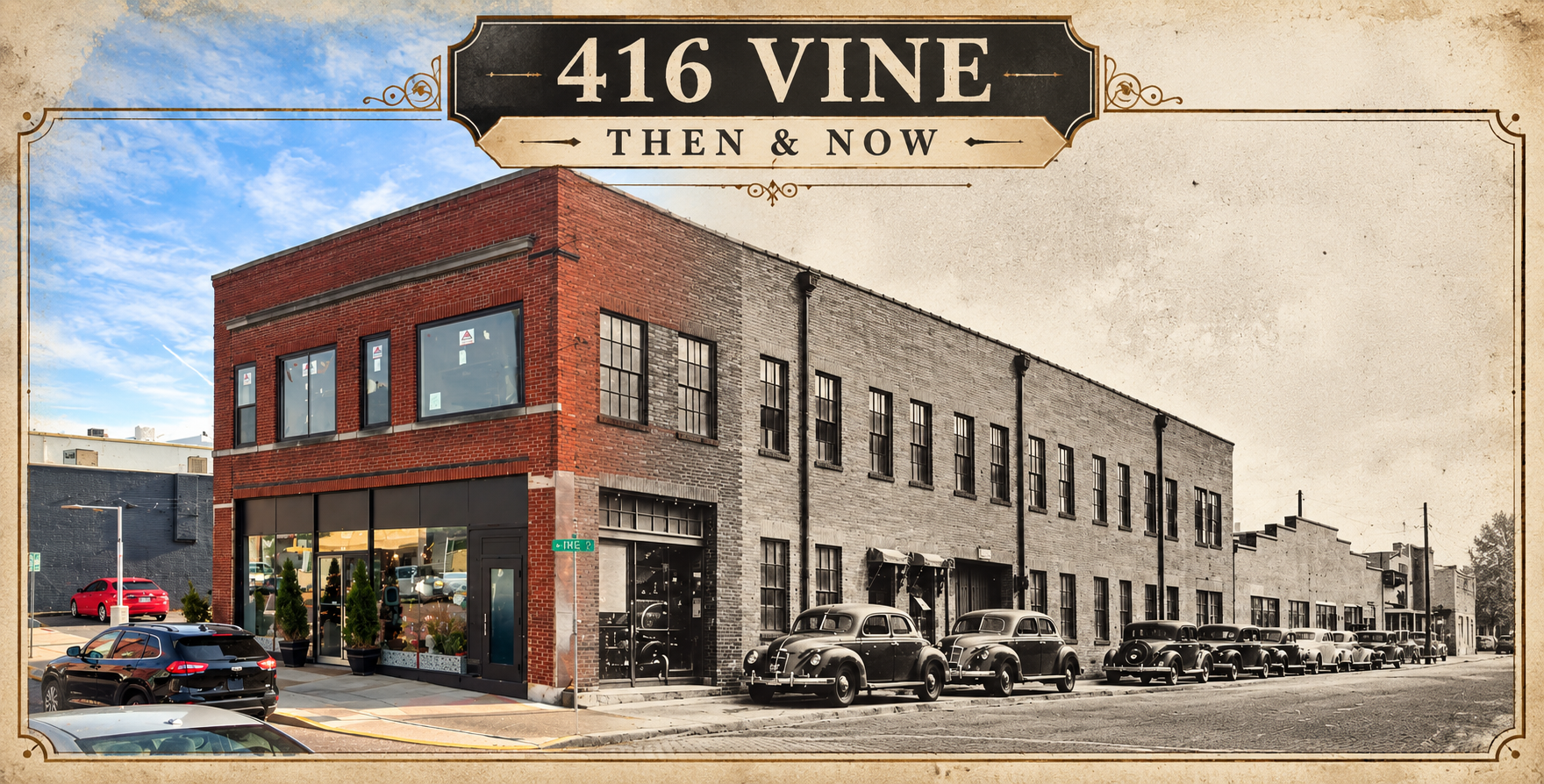
Then & Now — the plant as it appeared in the 1950s above, the same facade today below. Disclosure: this composite is a modern graphic; both views are enhanced, reconstructed renditions rather than untreated archival scans. The unaltered source photographs follow.

The plant as it appeared in 1954, with HOLCOMB MACHINE WORKS painted across the facade and three cars at the curb. This untreated scan is the source of the enhanced view used in the Then & Now comparison.

623 South Fifth Street today — a chain-link fence and concrete barrier across the front, the sign lettering gone, and the concrete frame unchanged. This is the untreated photograph behind the present-day half of the Then & Now comparison.

An earlier view along the Holcomb frontage: a two-story masonry building with a full-width ground-floor porch, bare trees, and an unpaved street. The building, date, and photographer are not yet identified — it is included here as a comparison view of the same block, held for future identification.

The signed facade of Holcomb Machine Works, seen from across the street with a street lamp and two late-1930s or 1940s automobiles. This appears to be a second scan of a view already represented in this gallery; its source, date, and photographer are unverified.
Historic Poplar Bluff
Story Contributor
Source:
Poplar Bluff Republican (Jan. 28, 1909); Poplar Bluff City Directory 1914; Daily American Republic (May 10 & 13, 1927; June 29, 1927; May 9, 1928; Mar. 1, 1952; Dec. 31, 1954; Mar. 4, 1957); Weekly Citizen Democrat (June 9, 1949).
Related Historic Sites

People in This Story
William Allen (W.A.) Holcomb
b. 1861 d. 1952
Frank Hoysardt Holcomb
b. 1890 d. 1957
Kittie Holcomb
d. 1951
Hester M. (Holcomb) Richmond
View profile
Marguerite Holcomb
View profile
Robert Breuer Sr.
Foundry proprietor
Winfield Holcomb
View profile
Kittie (Holcomb) Reed
View profile
E. C. Thomas
Construction company official