
Contents
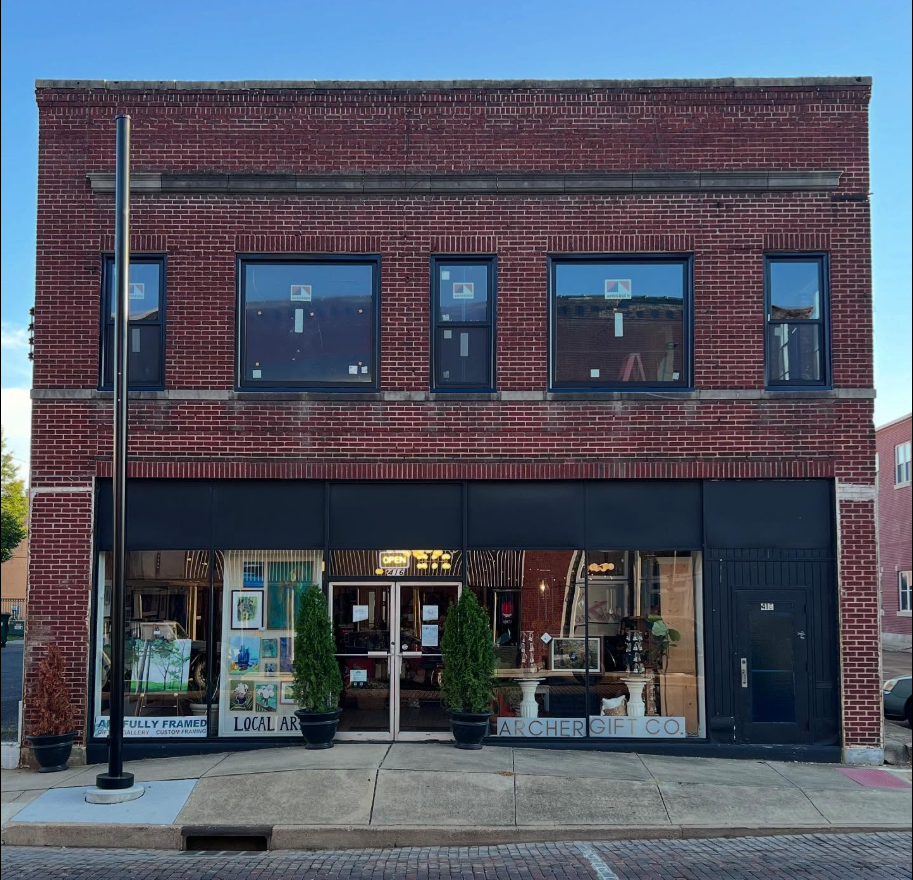
On the corner of Vine and Moran streets in downtown Poplar Bluff stands a long, two-story brick building. Today, the storefront at 416 Vine Street is home to Archer Gift Co.. To someone passing the building without knowing its history, there may be little reason to suspect just how much of Poplar Bluff's story has unfolded on this corner.
Look more closely, however, and the building begins to reveal its age. Rows of tall windows extend along its side. Old openings have been filled or altered. Brickwork records changes made by different generations. Even the street beside it is younger than much of the history contained within its walls.
More than a century ago, this was horse country.
Before automobiles filled Vine Street, horses were boarded here. Carriages departed for weddings, funerals and the railroad depot. Stablemen groomed teams. Travelers could hire a single or double rig. Later, mechanics repaired automobiles in rooms where horses had once been kept. A garage eventually advertised space for dozens of cars.
The property endured floodwater and the devastating tornado of 1927. It housed automobile dealers, merchants and, for nearly half a century, Jim Faith's Business Equipment. Its history is not the story of one business or even one building frozen in time. It is the story of a place that repeatedly changed with Poplar Bluff.
And that story begins with the horse.
A Livery on Vine Street
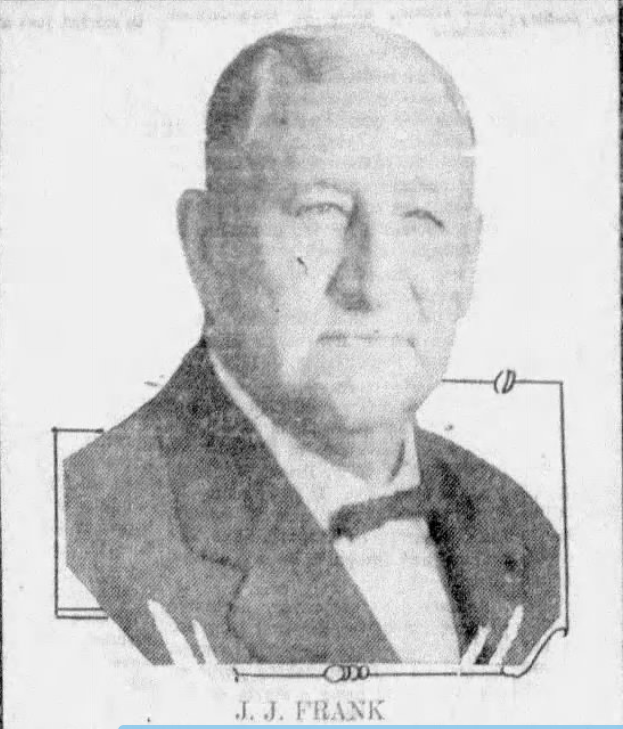
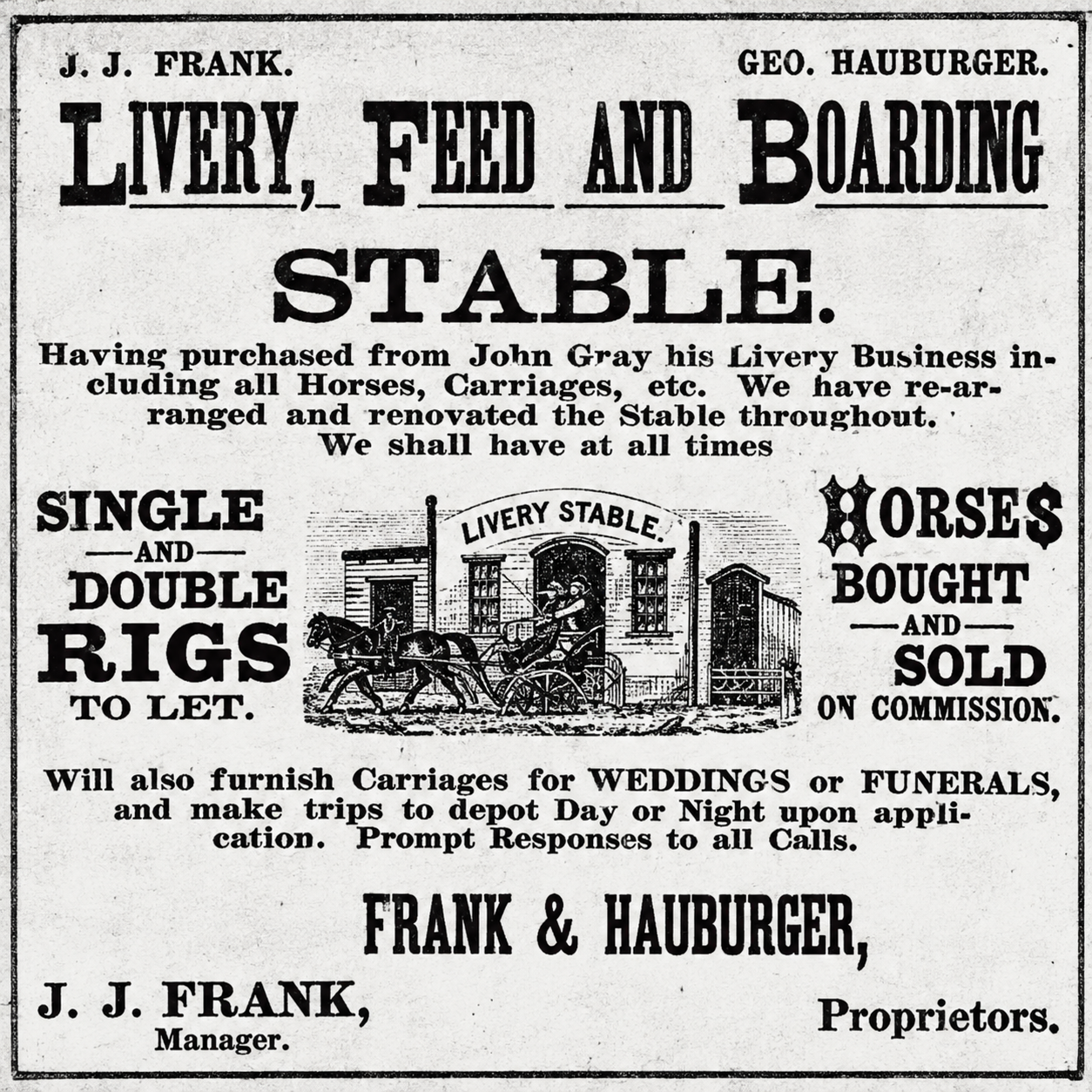
One of the earliest pieces of the story appeared in a Poplar Bluff newspaper in the summer of 1889. An advertisement announced that J. J. Frank and George Hauburger had purchased the livery business of John Gray. Under the name Frank & Hauburger, they offered a full range of services expected from an important nineteenth-century livery operation: single and double rigs, horses bought and sold on commission, carriages for weddings and funerals, and transportation to and from the railroad depot at any hour.
J. J. Frank was identified as manager. Exactly where John Gray's business had operated has not yet been established, so it would be premature to place the 1889 transaction directly at today's 416 Vine Street. Within only a few years, however, Frank can be placed securely on this property.
A Sanborn fire insurance map from 1895 identifies J. J. Frank Livery & Feed at the Vine Street site.
The map captures a Poplar Bluff very different from the one we know today. Fifth Street was nearby, but the street now called Moran did not yet exist in its familiar form. Railroad property shaped the surrounding blocks. Across Vine stood an undertaking establishment.
At the Frank property, horses rather than automobiles defined the business. By this point, Frank had become an established figure in Poplar Bluff's transportation economy.
And the business was growing.
Building a Bigger Stable
In September 1899, the Poplar Bluff Republican reported that Frank had begun construction of a major addition to his brick livery stable. The addition was to be built on the east side of the existing stable. It would measure 50 feet wide and the same length as the building already occupied. The newspaper described a brick front and rear, with a sheet-iron side and roof.
That report is especially valuable because it tells us that the property was not a static structure even at the turn of the twentieth century. It was already being enlarged and modified to accommodate a growing business. The 1901 Sanborn map leaves little doubt about the occupant.
Across the building appears the label:
J. J. FRANK LIVERY
By then, the Vine Street operation had become a substantial commercial stable complex. The precise relationship between every wall shown on these early maps and the building standing today remains a subject for continued study. The property would be remodeled repeatedly, suffer tornado damage and undergo major changes during the automobile era. We therefore cannot simply say that today's building was constructed in 1895 or 1899.
What we can say is more interesting:
The commercial complex from which today's 416 Vine Street developed was already firmly established here during the horse-and-carriage era of the nineteenth century.
Frank Sells to Jim Hogg
A major change came in March 1906.
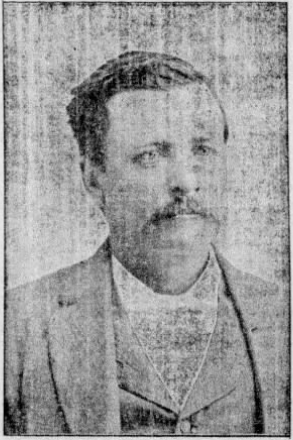
James R. "Jim" Hogg purchased Frank's livery operation. The Daily Republican described the transaction as involving Frank's entire business—horses, carriages and building, along with everything connected to the operation. The reported price was $18,000, a considerable investment for the period.
This distinction matters.
Many later transactions involving the property transferred only the operating business while the building remained in someone else's hands. In the 1906 transaction, however, the newspaper specifically included the building. Hogg was already experienced in the livery and feed business and initially planned to reorganize his operations. The former Frank barn would be used for livery purposes while his other facility could handle feed.
Some of Frank's experienced personnel remained.
One was Drew Hallock, described in a newspaper account as one of the best liverymen in the region. Hallock had reportedly worked for Frank for approximately twelve years, placing his association with the business back into the mid-1890s. The change in ownership therefore did not erase the continuity of the operation.
Instead, Hogg began modernizing it.
Modern Technology—For Horses
It is easy to think of a livery stable as belonging entirely to an older, technologically simple world.
Hogg's operation suggests otherwise.
Only weeks after acquiring the Frank property, newspapers reported that the stable was being equipped with modern appliances, including an electric currying and clipping machine.
Electricity had arrived at the horse barn.
Later that year, Hogg undertook an even more substantial improvement.
In September 1906, the Weekly Citizen Democrat announced:
"WILL ADD ANOTHER FLOOR"
Work had begun on Hogg's Vine Street livery barn. Contractor J. W. Linton had been engaged for the project.
The east room was to be raised into a two-story building while remaining part of the livery operation. Plans also called for a steel and plate-glass front. The resulting stable was described as an elegantly arranged facility. This construction may be important in understanding the physical evolution of the building still standing today. Frank had added a large eastern section in 1899; Hogg raised an east room to two stories in 1906.
Whether those descriptions refer to precisely the same portion of the structure remains unproven.
But the sequence is clear:
The Vine Street livery was being enlarged, modernized and rebuilt years before automobiles took it over.
Hogg & Malugen
By 1907 another name had entered the story.
A May newspaper article concerning the city fire department described its Vine Street location as adjoining Hogg & Malugen's livery stable. That seemingly incidental reference is useful for two reasons. First, it confirms that W. A. Malugen had become associated with Hogg's business.
Second, it places the city fire department immediately beside the livery property, helping reconstruct a portion of Vine Street that no longer looks the way it did then.
The partnership did not last indefinitely.
In April 1908, Hogg sold his half interest in the livery operation to his partner, W. A. Malugen, who had reportedly been associated with him for about a year.
But the newspaper made an unusually important distinction:
Malugen purchased the business interests.
Hogg retained the building.
That single detail illustrates one of the challenges in reconstructing the history of 416 Vine Street. The owner of the business was not necessarily the owner of the property. From this point forward, those two histories sometimes follow different paths.
Malugen Brothers
W. A. Malugen was soon joined by his brother.
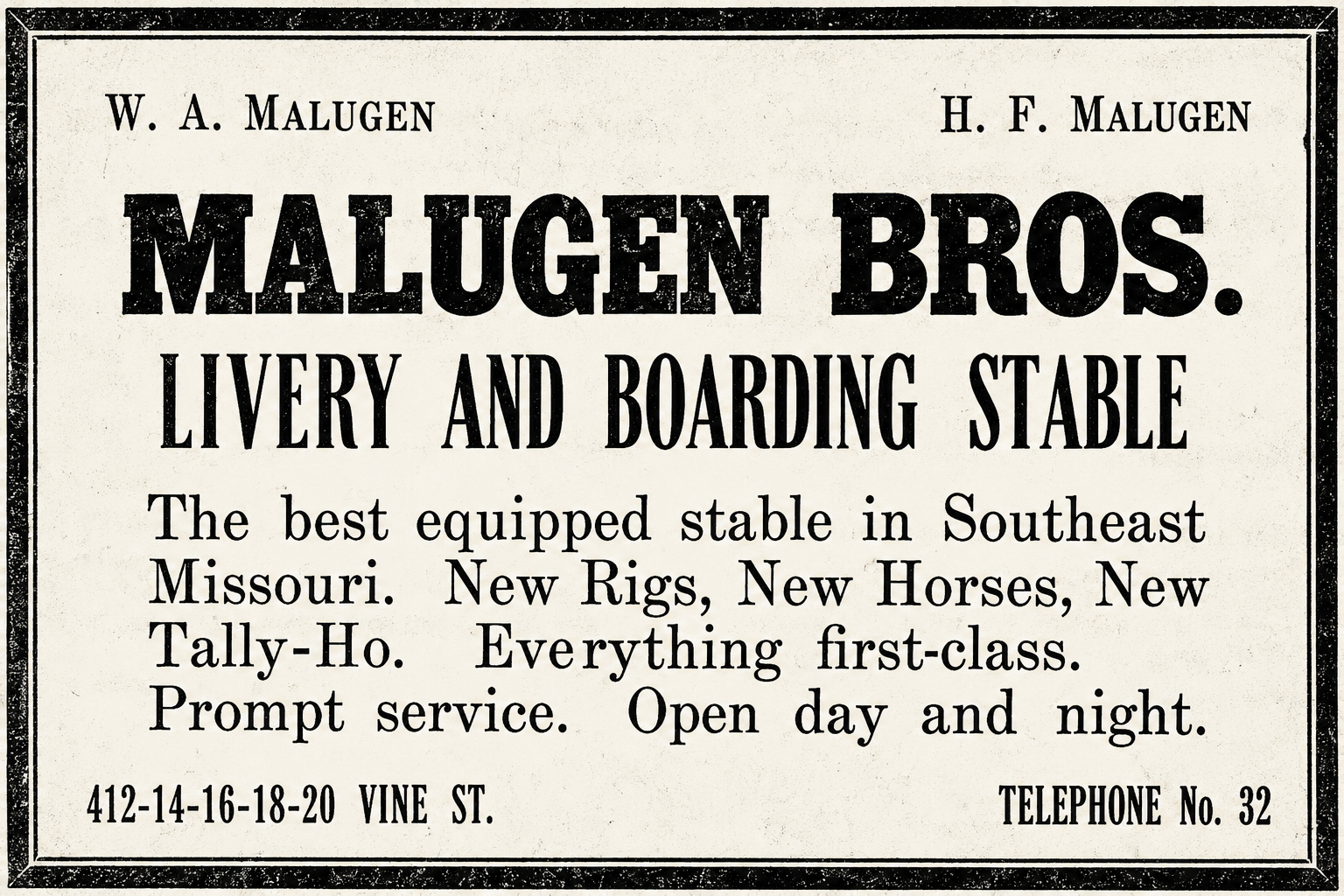
By late 1908, newspaper advertising identified the operation as:
LIVERY AND BOARDING STABLE
The advertisement listed W. A. Malugen and H. F. Malugen and gave an unusually revealing address:
412-14-16-18-20 Vine Street
The business advertised itself as one of the best-equipped stables in Southeast Missouri, offering new rigs and horses, a Tally-Ho and service day and night. Another article in 1909 praised a matched bay team at Malugen Brothers and declared that no stable in Southeast Missouri could furnish a finer turnout. Most importantly, an surviving period postcard provides a rare photographic glimpse of this chapter. Looking west along Vine Street, the words "MALUGEN'S LIVERY" can be seen prominently on the south side of the street. The photograph, newspaper evidence, addresses and Sanborn maps combine to make the identification particularly strong.
This was not some unrelated Malugen stable elsewhere in town. It was the successor operation occupying the former J. J. Frank livery property—the same historic commercial complex that would later house automobile businesses and ultimately include today's 416 Vine Street.
Frank Comes Back
While Hogg and the Malugens operated the Vine Street stable, J. J. Frank had not simply disappeared. For a time, he relocated to Sedalia, Missouri, where he established another substantial livery operation. In 1907, newspapers reported that Frank sold his Sedalia stable for $20,000.
He then returned to Poplar Bluff and increasingly entered another business with which his name would become closely associated:
undertaking.
In 1910, Frank acquired the undertaking business formerly operated by George Begley. The new operation became the Frank Livery and Undertaking Company. Its undertaking department offered caskets and coffins as well as paints, oils, glass, pictures, picture frames and wall moldings. Frank was described as a trained and licensed embalmer.
Later that year the company incorporated with J. J. Frank, Walter Frank and H. I. Ruth as incorporators and capital stock of $15,000.
The undertaking establishment was located across Vine from the old livery property, an important distinction that later maps help clarify. Frank was therefore involved with businesses on both sides of Vine Street—but they should not be collapsed into one building. Then, in March 1911, another major change occurred. The Frank Livery and Undertaking Company purchased the Malugen Brothers livery stable.
The newspaper reporting the sale made the historical connection explicit:
J. J. Frank had formerly owned the stable.
The livery business had effectively traveled in a circle:
Frank → Hogg → Hogg & Malugen → Malugen Brothers → Frank interests again. The real-estate history is somewhat less complete. We know Hogg bought the building in 1906 and explicitly retained it when Malugen acquired the business in 1908. At some point afterward, ownership returned to Frank, because later records clearly identify the building as Frank property. The precise transaction returning the real estate from Hogg to Frank has not yet been located.
The Automobile Arrives
By the middle of the 1910s, the greatest threat to the livery business was no mystery.
It was parked outside.
The automobile was rapidly changing how Americans traveled, and in December 1915 a Poplar Bluff newspaper documented the transition at the old Frank stable with remarkable clarity. Williams Brothers announced plans for a modern automobile operation in the west room of the Frank Livery and Undertaking Company's building. The newspaper explained why space had become available. Automobiles had reduced the demand for boarding horses.
People who once owned horses now owned cars.
The remaining horse business could be accommodated in the livery building to the east. For a time, then, the old property embodied two transportation eras simultaneously.
On one side:
horses.
On the other:
automobiles.
A Garage Inside the Old Livery
Williams Brothers planned an impressive facility. The first floor would accommodate automobiles, including space for display and demonstration. Their machine shop would occupy the second floor. An elevator capable of lifting a 6,000-pound automobile would carry cars between floors.
The building would be steam heated.
It was described as a modern and well-equipped plant. The transformation can be seen directly on the 1917 Sanborn map.
The western portion of the property is labeled:
GARAGE
Capacity: 30 CARS
Immediately beside it is another unmistakable label:
LIVERY
Few pieces of evidence tell the story of transportation change more effectively. In a single building complex, Poplar Bluff's nineteenth-century transportation system and twentieth-century transportation system stood side by side.
The horse had not disappeared.
But its space was shrinking.
The Last Horse Years
On January 1, 1918, another operator took over the remaining livery and feed business. Dan Peterson purchased the stock and business from the Frank company.
Once again, the newspaper carefully distinguished between business and property:
the building was retained by the Frank Company.
Peterson therefore purchased the operating livery, not the real estate. Frank explained that his undertaking business had grown to the point that it required his full attention. He also remarked that, except for a year or so, he had been associated with the livery business there for approximately thirty years.
But Peterson's ownership was tragically brief.
Only weeks later, he became ill with pneumonia.
Daniel Peterson died on January 27, 1918.
His tenure as proprietor of the livery had lasted less than a month. What happened to the horse business immediately afterward remains one of the smaller unresolved questions in the property's history. For a time, directory evidence continued to associate the Frank name with livery operations. Whether this reflected an active stable, a business classification that lingered, or a reorganized operation still requires further documentation. But by the following year, another major change was underway.
From Stable to Store
In October 1919, the Poplar Bluff Republican reported that a Vine Street building "formerly known as the Frank Livery barn" was being remodeled for a new tenant:
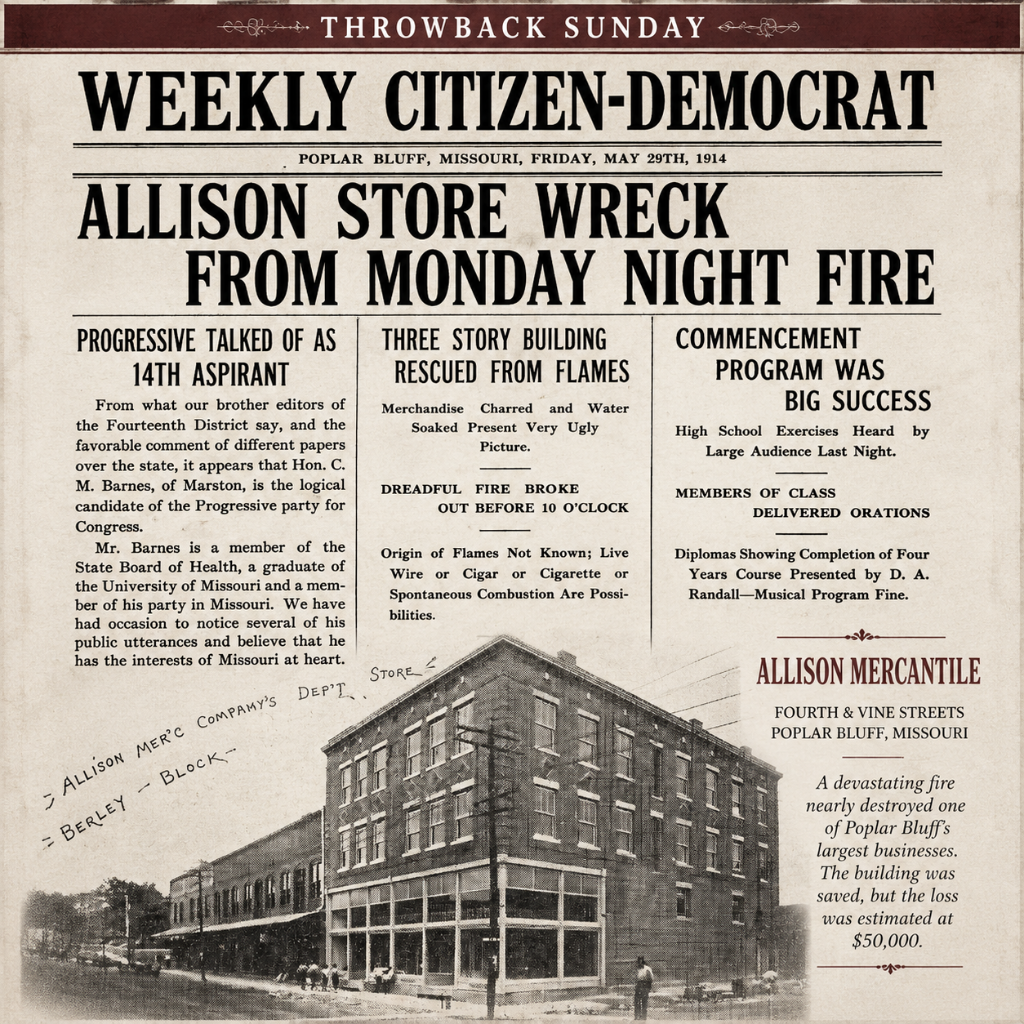
the Allison Mercantile Company.
The transformation was substantial.
The newspaper described one of the most commodious store rooms in Poplar Bluff, surpassed in size only by the Barnes Wholesale Grocery building.
The main store room measured approximately:
132 feet by 52 feet.
The former stable had been remodeled and specially arranged for mercantile use. This discovery adds an important chapter to the building's transformation.
The progression was not simply:
livery → garage.
Instead, portions of the sprawling property were repeatedly adapted. In 1917, the complex contained a 30-car automobile garage beside a working livery. In January 1918, Peterson briefly operated the remaining horse business. By October 1919, substantial former livery space was being remodeled for Allison Mercantile.
Exactly how the Allison space related to Williams Brothers' automobile operation remains under investigation. The available evidence strongly suggests a subdivided complex capable of accommodating different businesses at the same time. Within only a few more years, however, the automobile would dominate the property.
Even Frank Goes Motorized
There is an almost poetic footnote to the story.
By 1921, even J. J. Frank's undertaking business had embraced the automobile. That April, the Daily American Republic reported that Grover Greer, manager of the Poplar Bluff Casket Factory, had completed a specially constructed casket truck for the Frank Undertaking Company. Greer built the body on a new Ford chassis purchased from the Butler County Auto Company.
The truck was finished in dull gray with darker gray striping. For a man whose Poplar Bluff career had been built partly around horses, carriages and livery service, the symbolism is difficult to miss. Frank's old stable was becoming automobile space. And Frank's undertaking business was now transporting its equipment by Ford.
The horse era was ending throughout the city.
Williams Moves Out
Williams Brothers remained in the Frank building until 1922. That March, newspapers reported that the firm was moving across Vine Street into the Begley building. Williams planned to discontinue the garage portion of its business while continuing machine and repair work.
The move would allow J. J. Frank to make improvements to his Vine Street building. Almost immediately, another name entered the property. Garner Brothers moved into the former Williams quarters.
A newspaper account described their new location in unmistakable terms:
the old Frank Livery barn at Vine and the Frisco tracks. Nearly thirty years after Frank's livery had appeared on the 1895 Sanborn map, people in Poplar Bluff still recognized the property by that name. But there would soon be very little livery about it.
The Garner Era
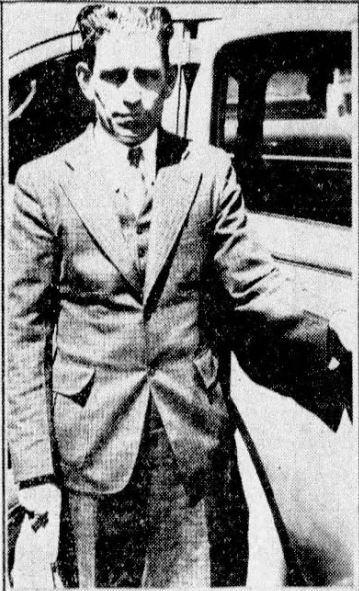
The Garner automobile story centered on Homer L. Garner, better known throughout Poplar Bluff as "Honkey" Garner.
Homer had already been associated with automobiles before moving into the Frank property. A 1920 classified advertisement for a Ford touring car at Broadway Garage instructed prospective buyers to:
"Ask for Homer Garner."
Garner Brothers initially involved Homer and Alva A. Garner. In March 1923, Alva sold his interest in Garner Brothers to Homer, who assumed the firm's accounts and obligations.
Homer Garner was now firmly in control.
Only months later, nature demonstrated one of the disadvantages of the low-lying Vine Street location.
Six Feet of Water
In June 1923, Poplar Bluff experienced serious flooding.
The Daily American Republic described conditions at the Garner property vividly:
"The swirling water, six feet deep, swept through Garner Bros. garage." The same building complex that had housed horses, carriages and automobiles was now standing in deep floodwater.
Yet the business continued.
And within a year, the scale of the automobile operation had increased dramatically.
A 75-Car Garage
The 1924 Sanborn map documents just how thoroughly the property had changed.
The livery label was gone.
In its place was a large garage complex with a listed capacity of:
75 CARS
The mapped range extended through multiple Vine Street addresses, including 418, 416, 414, 412, 410–408, 406, 404 and 402.
The map also records physical details:
- electric lighting,
- stove heat,
- concrete flooring,
- steel trusses,
- iron posts.
Only seven years earlier, the Sanborn map had shown a 30-car garage beside a livery stable. Now the complex could accommodate 75 automobiles. The precise sequence of alterations that produced this expansion remains partly unresolved. Williams' departure, Frank's planned improvements, Garner's arrival and the earlier Allison Mercantile conversion all fall within the transition. It would therefore be too simple to attribute the entire expansion to a single remodeling project.
What is unmistakable is the larger change.
By 1924, the horse had lost the property.
The automobile had won.
418, 416, 412
The historical addresses can initially seem confusing. Garner Motor Company appears at 418 Vine in period records.
Later Garner references use 412 Vine.
Today the surviving corner building is identified as 416 Vine Street. Earlier Malugen advertising listed the enormous range of 412-14-16-18-20 Vine Street.
The 1924 Sanborn map helps explain why.
This was not necessarily a succession of businesses repeatedly moving up and down the block. The historic commercial complex extended through multiple numbered entrances and sections. Consequently, an address such as 418, 416 or 412 may identify a particular entrance, office or portion of a much larger interconnected property. We should therefore resist forcing modern assumptions about a single street number onto a complex that historically occupied several.
May 9, 1927
Then came one of the darkest days in Poplar Bluff history. On May 9, 1927, a devastating tornado tore through the city.
The Garner property was struck.
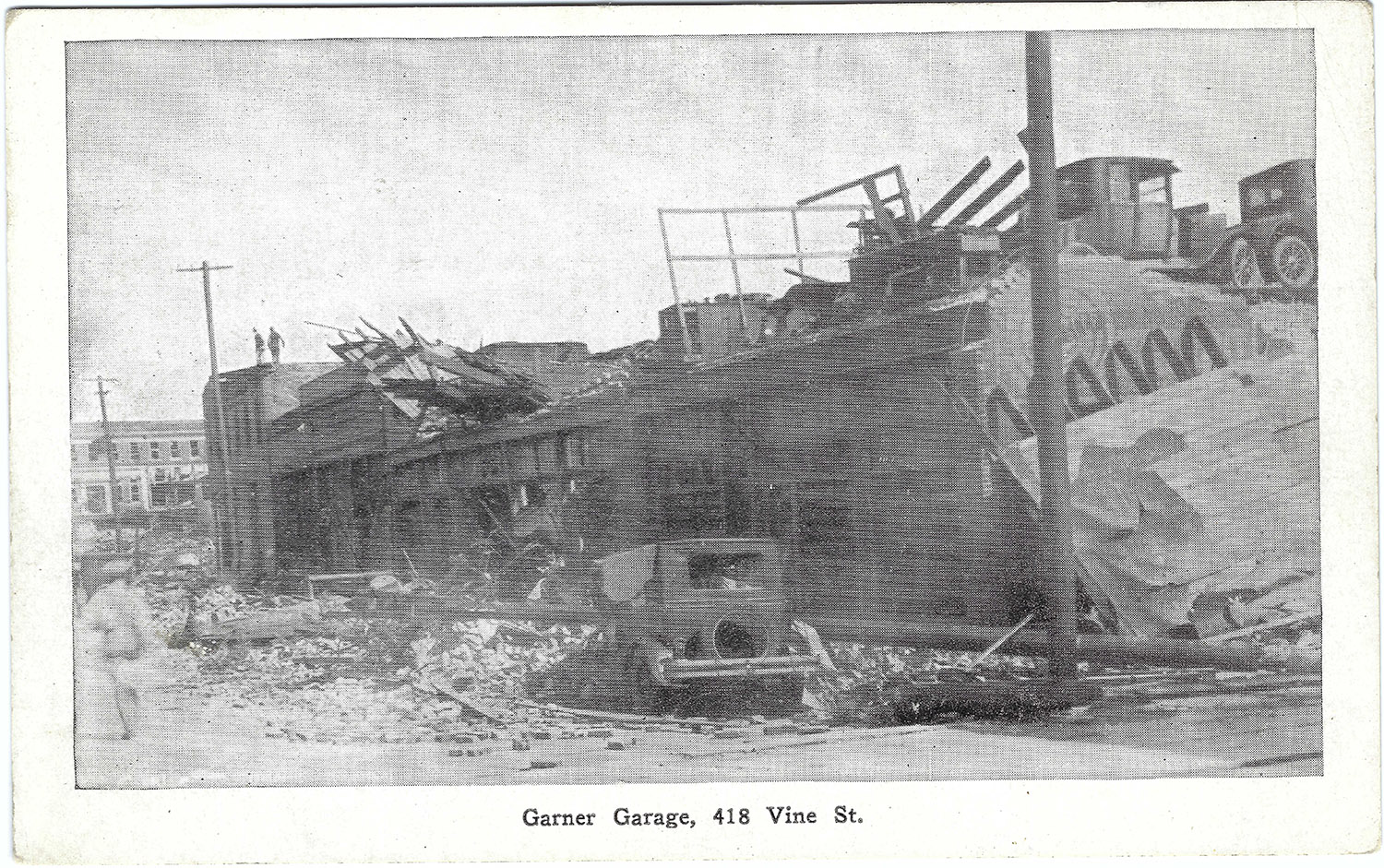
Contemporary reporting stated that the Garner Motor Company building was partly wrecked. A surviving postcard photograph captioned "Garner Garage, 418 Vine St." shows the destruction. The image is especially valuable because surrounding buildings help anchor the location to the modern streetscape. But the damaged Garner building was not abandoned. Nor was it simply replaced without connection to what had stood there before.
Two months after the tornado, newspapers reported that J. J. Frank was beginning restoration of two buildings. One was the property occupied by Garner Motor Company.
The newspaper explained that the Garner building had been a two-story structure. The tornado had blown off the second story and damaged the first.
Then came the critical statement:
The Garner Motor Company building was to be restored as a two-story building. That wording gives us an important bridge between the pre-tornado and post-tornado structure. The building standing after 1927 was not merely an unrelated new building placed on the old site. It represented the restoration and reconstruction of the tornado-damaged property. Exactly how much nineteenth- and early twentieth-century masonry survived that reconstruction remains an open architectural question.
But the historical continuity of the property is clear.
A Street Called Moran
The building itself was not the only thing changing.
The street beside it was changing too.
For much of the property's early history, today's Moran Street did not exist in its modern form.
The railroad dominated the area.
Then, in April 1928, Poplar Bluff's city council addressed a street with a decidedly less dignified name:
Sewer Street.
The council unanimously renamed it Moran Street in honor of J. W. Moran, superintendent of the Frisco's river division. Moran was credited with helping secure Poplar Bluff's new $40,000 Frisco depot and with helping resolve a long-standing problem involving the Frisco's open sewer. Newspapers predicted that Moran Street would become an important business artery.
Later that year, the city began planning improvements. Maple Street had been vacated for Frisco use. A new concrete storm sewer was ordered. Railroad tracks were to be moved to the west side of the new station. Once that work was completed, Moran Street could be improved for traffic.
By January 1929, the Frisco was unloading several railroad cars of chat to surface the street. The railroad furnished the material while the city prepared and opened the route. Moran now ran over the new covered concrete storm sewer and provided a direct passage between Maple and Vine.
The transformation is striking.
While the old livery property was becoming a modern automobile dealership, the streets and railroad infrastructure surrounding it were also being reconstructed for a new transportation age.
The Home of Honkey Garner
By the mid-1920s, directories identify Garner Motor Company at 418 Vine. Homer L. Garner was proprietor. The company sold and serviced automobiles and advertised Chrysler models.
Later advertising promoted the business as:
"Home of Honkey Garner Motor Co."
One advertisement boasted of years of service as an automobile headquarters for Southeast Missouri. The company employed a substantial staff, maintained dozens of new cars, offered wrecker service and sold Chrysler and Plymouth automobiles. The business had become far more than a small neighborhood garage. The old livery property had become an automobile center serving a broad region. Garner himself would remain associated with Poplar Bluff's automobile industry for decades.
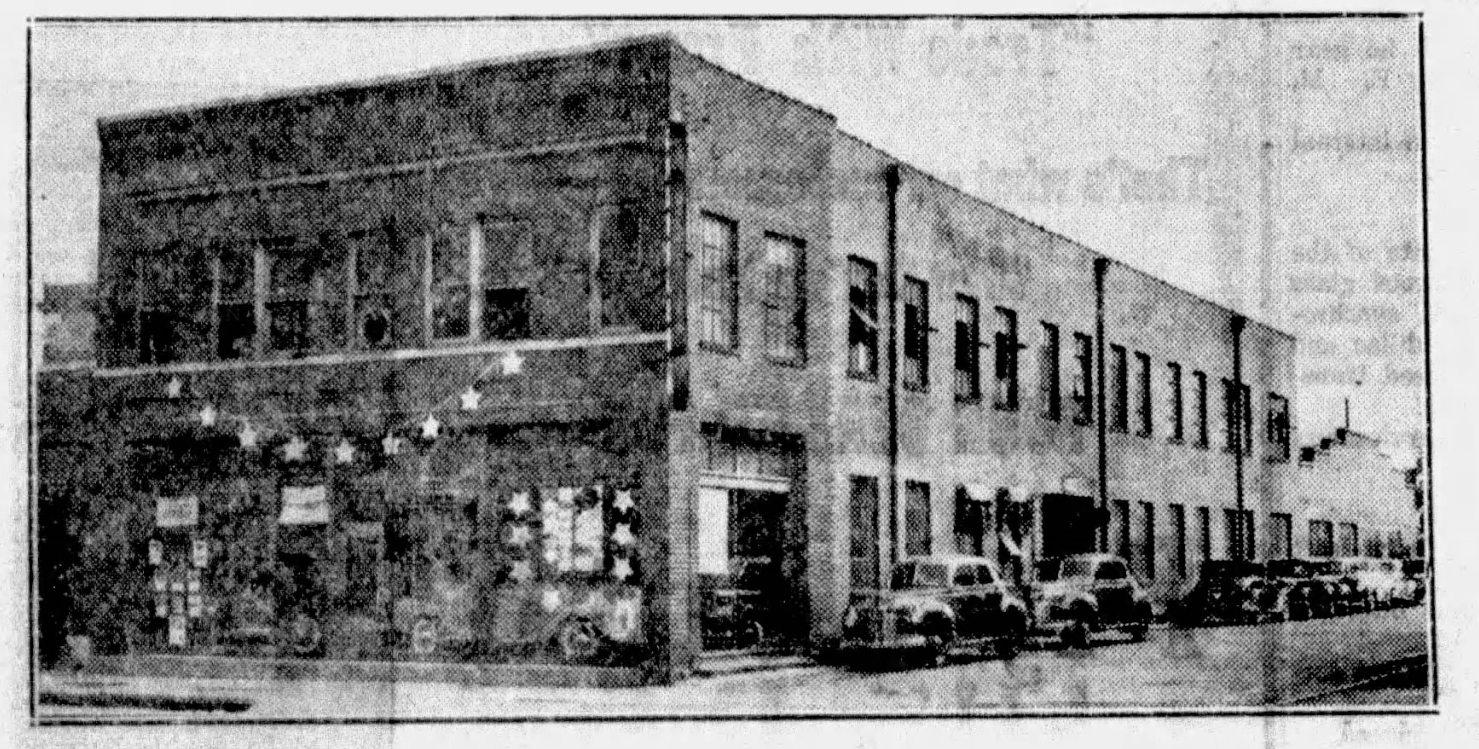
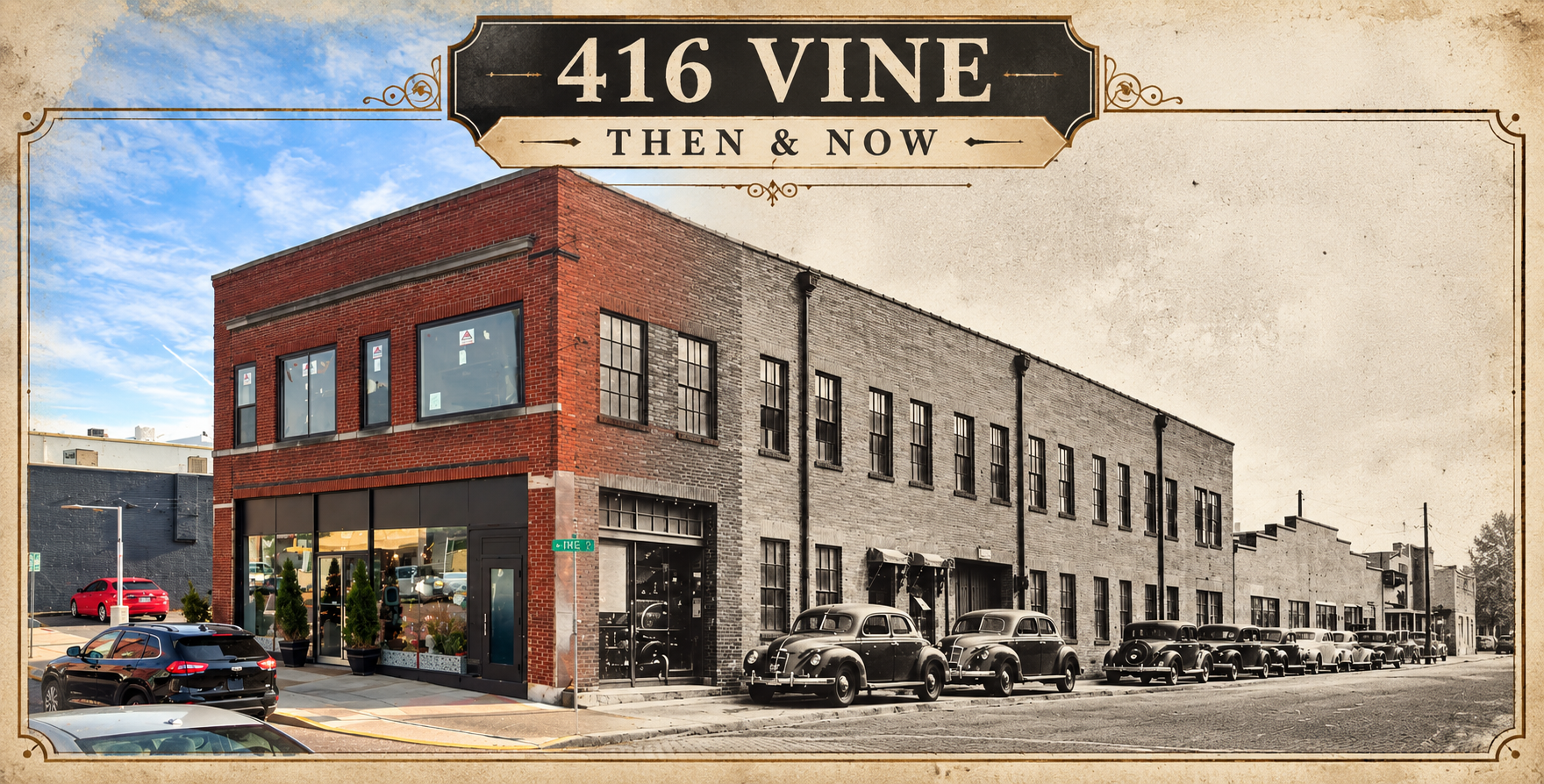
His 1990 obituary recalled that he had worked in the automobile industry from the age of fourteen and eventually became one of the region's major automobile distributors. He also later owned and operated the Tower Court Motel. The exact chronology of every Garner-era change to the Vine Street property remains an area for further research. But a photograph from around 1941 provides one of our clearest views of the building after the tornado reconstruction. And suddenly the modern building becomes unmistakable.
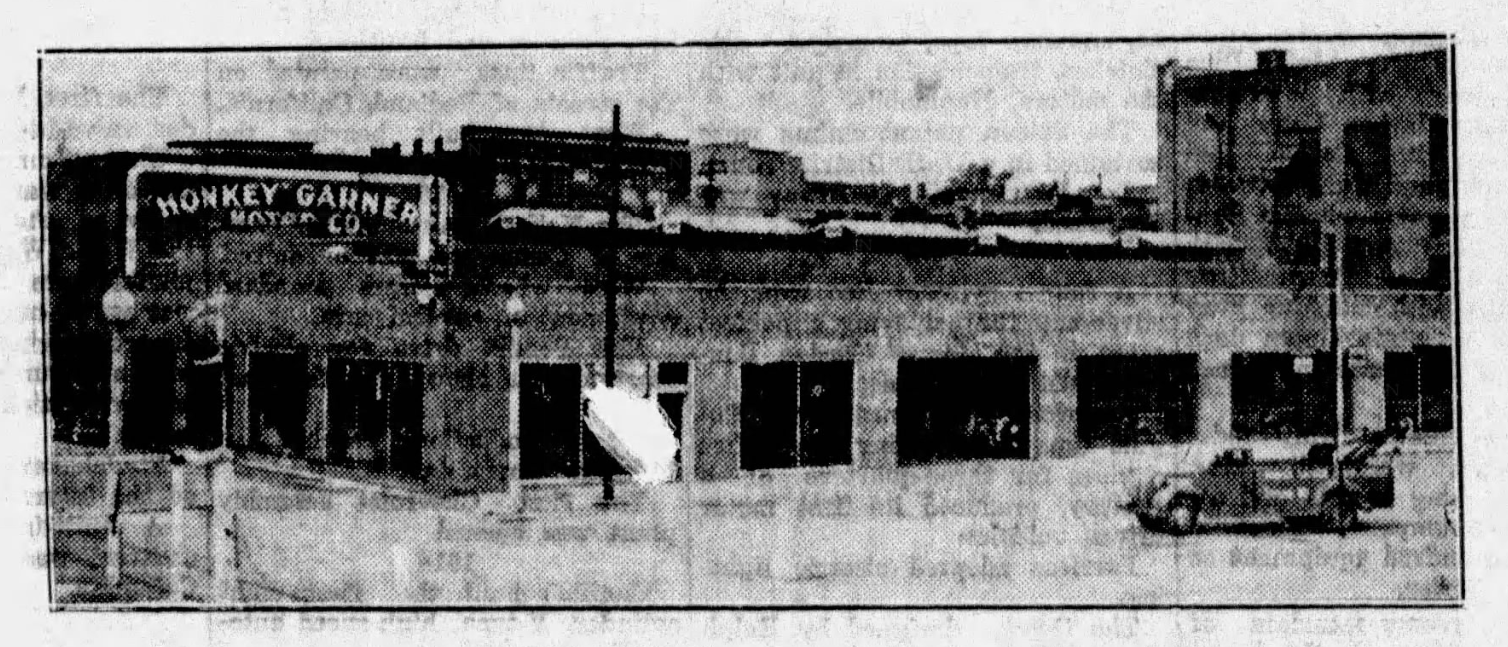
Look at the Windows
The 1941-era photograph shows a long, two-story brick building extending down the block.
Compare it with 416 Vine Street today.
The correspondence is striking.
The corner massing is there.
The long side elevation is there.
The rhythm of the upper-story windows is there.
Large openings associated with the automobile business can still be interpreted in portions of the lower wall, although many have subsequently been filled or altered. This photograph provides one of the strongest visual links between the Garner era and the building standing today. The property had changed enormously since the days of J. J. Frank.
But the building had not disappeared from the story.
Another Business, Another Generation
At some point after the Garner era, the property entered another phase. This portion of the chronology still needs additional research. There may have been intermediate businesses between Garner's automobile operations and the company that would become most familiar to a later generation of Poplar Bluff residents.
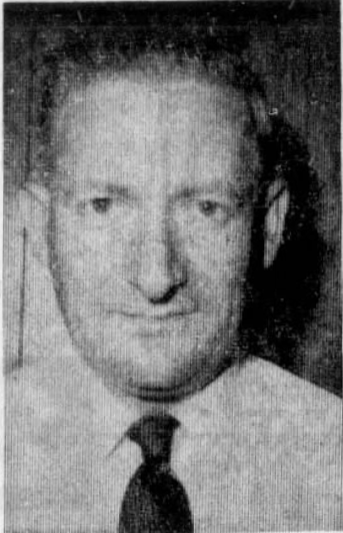
That business was Jim Faith's.
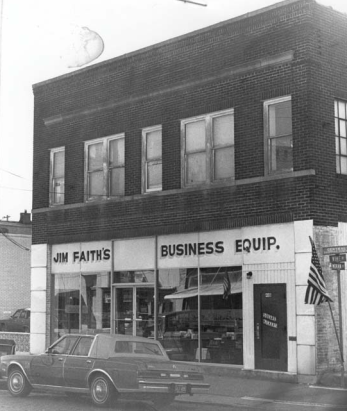
James H. "Jim" Faith became a longtime downtown businessman and operated Faith's Business Equipment, later advertised as Jim Faith's Office Supplies. Later advertisements stated that the business had occupied 416 Vine since 1971.
A photograph from 1990 shows the familiar storefront:
JIM FAITH'S
BUSINESS EQUIP.
Above it, however, the old brick building remains plainly recognizable. Another photograph from 2005 shows much the same scene. Faith's later advertising emphasized its longevity, stating that the locally owned business had been in the same location for more than 48 years. Jim Faith died in 2008, but the business continued. As late as 2019, advertisements listed Jim Faith's Office Supplies at 416 Vine Street, offering office supplies, furniture, catalogs and free in-town delivery.
A 2020 advertisement again emphasized the business's long tenure at the location. For nearly half a century, another generation of Poplar Bluff residents knew the former livery and automobile property not as Frank's barn or Garner's garage—
but simply as Jim Faith's.
416 Vine Today
The latest chapter in the story of 416 Vine Street is not one of abandonment or a building waiting to be rediscovered.
It is one of continued use.

Today, the historic Vine Street storefront is home to Archer Gift Co. and Artfully Framed, businesses owned and operated by Tad Long. Long does not own the building itself—a distinction worth making in a property history where ownership of the real estate and ownership of the businesses operating inside it have often been two different things.
Archer Gift Co. was created in December 2020 from Long's desire to bring a distinctive retail experience to Poplar Bluff. The shop combines locally made items with carefully selected brands and gifts, creating the kind of destination-oriented retail business that once made downtown commercial districts centers of everyday community life. Its sister business, Artfully Framed, adds another dimension to the building's present use. In addition to professional custom framing, it provides photo restoration and related preservation services and maintains a gallery featuring the work of local and regional artists.
There is an interesting historical echo here.
In 1910, when J. J. Frank expanded his business interests beyond the livery trade, his advertisements included pictures, frames and wall moldings. That operation may or may not have been inside today's 416 Vine building but creates an intriguing irony between Frank and Artfully Framed. More than a century later, it is difficult not to appreciate the coincidence that professional framing and art have once again become part of the commercial life of this corner of Vine Street.
But Archer and Artfully Framed contribute something else to downtown that is harder to measure simply by looking at a storefront.
They give people reasons to come downtown.
In addition to retail shopping and framing, the businesses regularly create opportunities centered around art, creativity and community participation. Painting, pottery and other creative classes and events turn the building into more than a place where a customer walks through the door, makes a purchase and leaves. Artfully Framed also provides a place for area artists to exhibit their work, while Archer has positioned itself as a locally rooted destination within downtown Poplar Bluff. That activity matters to the history of the building.
Historic commercial districts survive best when their old buildings remain useful. Preservation does not have to mean turning every surviving structure into a museum. In many cases, one of the best outcomes for an old commercial building is exactly what has happened here: keep it standing, maintain it, adapt it to contemporary needs and fill it with a business that gives people a reason to walk through the door. That has been the pattern at this property for well over a century. When Poplar Bluff traveled primarily by horse, the property served a livery.
When automobiles replaced horses, portions of the stable became a garage. When commercial needs changed again, former stable space became mercantile space. Garner turned the property into an automobile center. Later generations knew 416 Vine as Jim Faith's Business Equipment.
Today, Archer Gift Co. and Artfully Framed have adapted the historic storefront once again—this time for retail, art, framing and community activities. The businesses themselves have changed dramatically.
The underlying principle has not.
A downtown building survives when people continue finding reasons to use it. That makes the present chapter of 416 Vine Street more than an epilogue to its history. It is part of the same story.
For Historic Poplar Bluff, buildings like this represent exactly why the continued use and thoughtful repurposing of downtown's older structures matters. Their value is not limited to what happened inside them a century ago. They can remain useful, attractive and economically active places today while still carrying visible pieces of the city's past. At 416 Vine, history is not confined to an old photograph hanging on the wall.
People still shop here. Art is still displayed here. Keepsakes are still preserved here. Classes and events still bring people through the doors.
And the old building is still doing what downtown buildings were built to do:
serving the community.
More Than One Building's History
There is a temptation when researching an old building to search for a single construction date and a neat list of owners.
416 Vine resists that simplicity.
Its history is better understood as layers.
A nineteenth-century livery occupied the property.
Frank enlarged it.
Hogg purchased it and rebuilt portions of it.
Malugen operated it.
Frank interests returned.
Williams introduced automobiles while horses still occupied adjoining space.
Peterson briefly took over the remaining livery.
Former stable space was converted for Allison Mercantile. Garner transformed the property into a major automobile operation.
Floodwater swept through it.
A tornado tore away its second story.
It was restored.
The street beside it was rebuilt.
Garner's automobile business gave way eventually to other uses. Jim Faith's occupied the building for nearly half a century. Today Archer Gift Co. carries the commercial story forward. At several points, the person operating a business here did not own the building.
At several points, different businesses appear to have occupied different portions of the same sprawling complex. And at several points, the building itself was physically altered enough that assigning one simple construction date would obscure rather than clarify its history.
That complexity is not a weakness in the story.
It is the story.
From Horses to Horsepower
Perhaps the most remarkable period lasted only a few years.
Imagine standing on Vine Street around 1917.
Walk toward one part of the old Frank property and you encounter horses. There is feed, tack, harness, wagons and the familiar work of a livery stable. Walk into another portion of the same complex and you encounter an automobile garage capable of holding thirty cars.
A machine shop operates upstairs.
A heavy elevator can lift automobiles between floors.
Electric lights illuminate the garage.
Within a few years, former horse space becomes mercantile space.
Then the garage expands.
By 1924, Sanborn's map records room for seventy-five automobiles. The transition from horse to automobile—one of the most consequential changes in American daily life—did not happen abstractly in Poplar Bluff.
It happened inside buildings like this one.
In this case, we can nearly watch it happen room by room.
Look Closely. It's Still There.
More than 130 years have passed since J. J. Frank's livery was mapped on this Vine Street property.
The horses are gone.
The railroad landscape has changed.
Sewer Street became Moran Street.
The automobile garage disappeared.
Storefronts changed.
Windows were replaced.
Large openings were closed.
Signs came down and new signs went up.
Businesses opened, prospered and disappeared.
Yet the property remained.
That may be the most important part of the story. Historic preservation does not always mean that a building remains exactly as it appeared when it was constructed. Sometimes the history is visible precisely because a building was useful enough to be changed instead of discarded. 416 Vine Street survived because generations continued finding new uses for it.
A livery stable became automobile space.
Stable rooms became commercial rooms.
A regional automobile business became later retail and office space. And a building shaped by horses, automobiles, floodwater, tornado damage and more than a century of commerce still stands on the corner. The next time you pass 416 Vine Street, look above the modern storefront.
Look at the brick.
Look at the upper windows.
Then look down the long side of the building toward what is now Moran Street.
Poplar Bluff changed around it.
The building changed with Poplar Bluff.
And more than a century later, the story is still there.
Photos
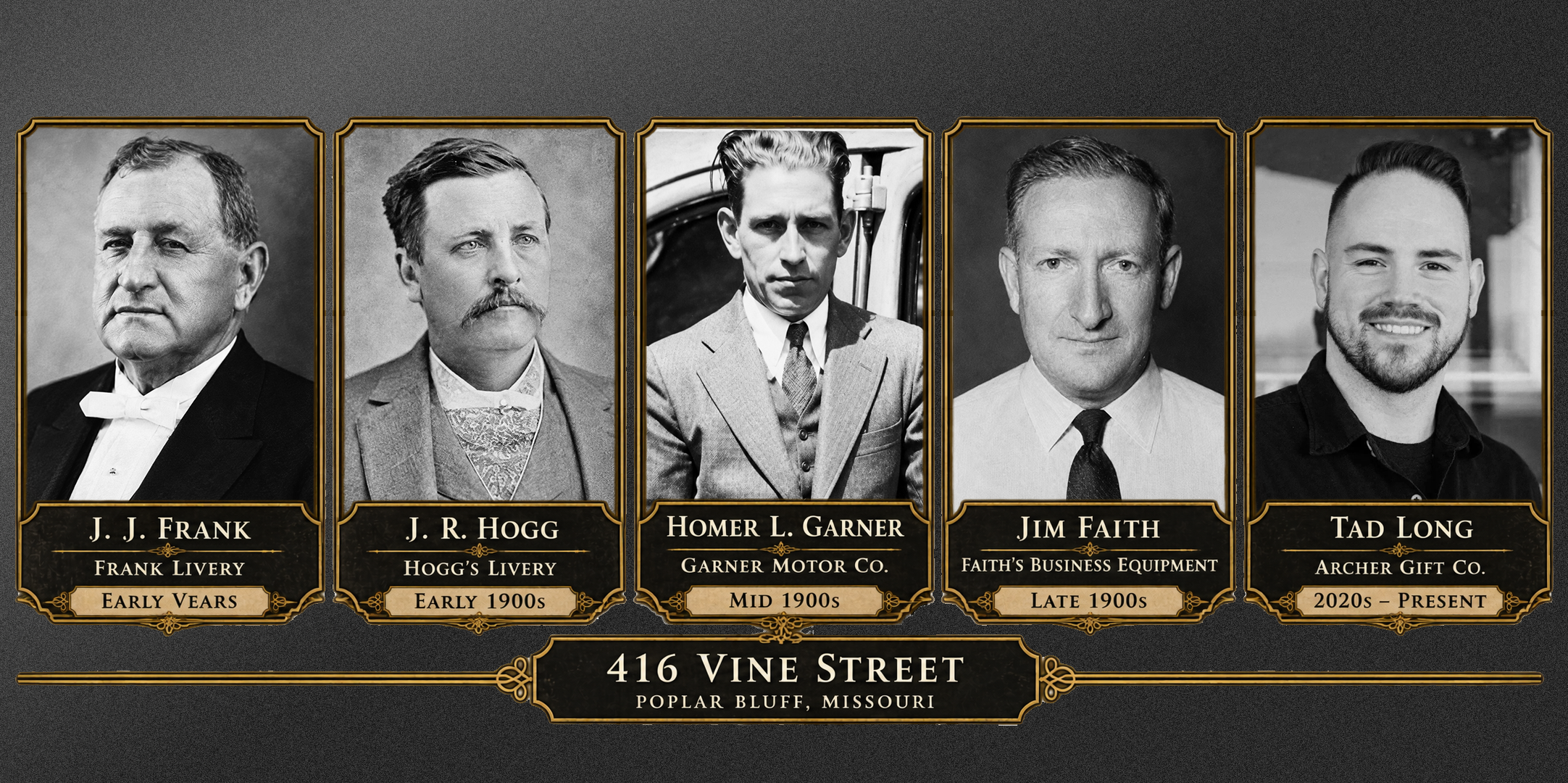
Five chapters at 416 Vine Street: J. J. Frank (Frank Livery), J. R. Hogg (Hogg’s Livery), Homer L. Garner (Garner Motor Co.), Jim Faith (Faith’s Business Equipment) and Tad Long (Archer Gift Co.).
Sanborn Fire Insurance Maps
Fire insurance maps show how the buildings on this property changed from decade to decade. Use the years below to move through the sheets, or expand for a closer look.
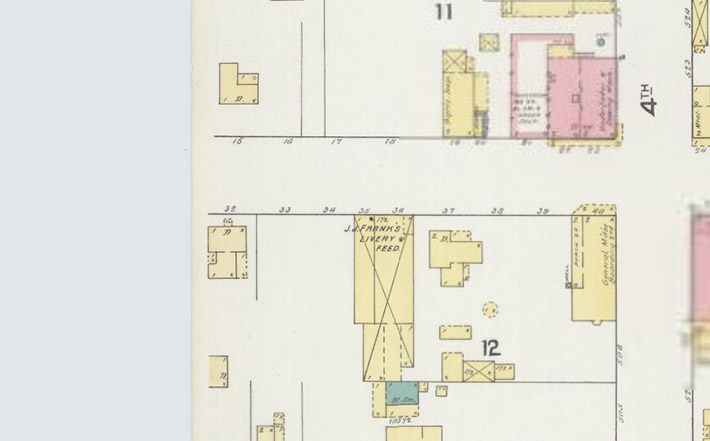
J. J. Frank Livery & Feed on the corner, with a blacksmith shop just behind.
Historic Poplar Bluff
Story Contributor
Source:
Poplar Bluff Republican (Sept. 1899; Oct. 1919), Daily Republican (March 1906), Weekly Citizen Democrat (Sept. 1906), Daily American Republic (April 1921; June 1923), Sanborn fire insurance maps (1895, 1901, 1917, 1924), Poplar Bluff city directories, and period postcards in the Historic Poplar Bluff collection.
Related Historic Sites
J. J. Frank Livery
412 Vine Street, Poplar Bluff, Missouri
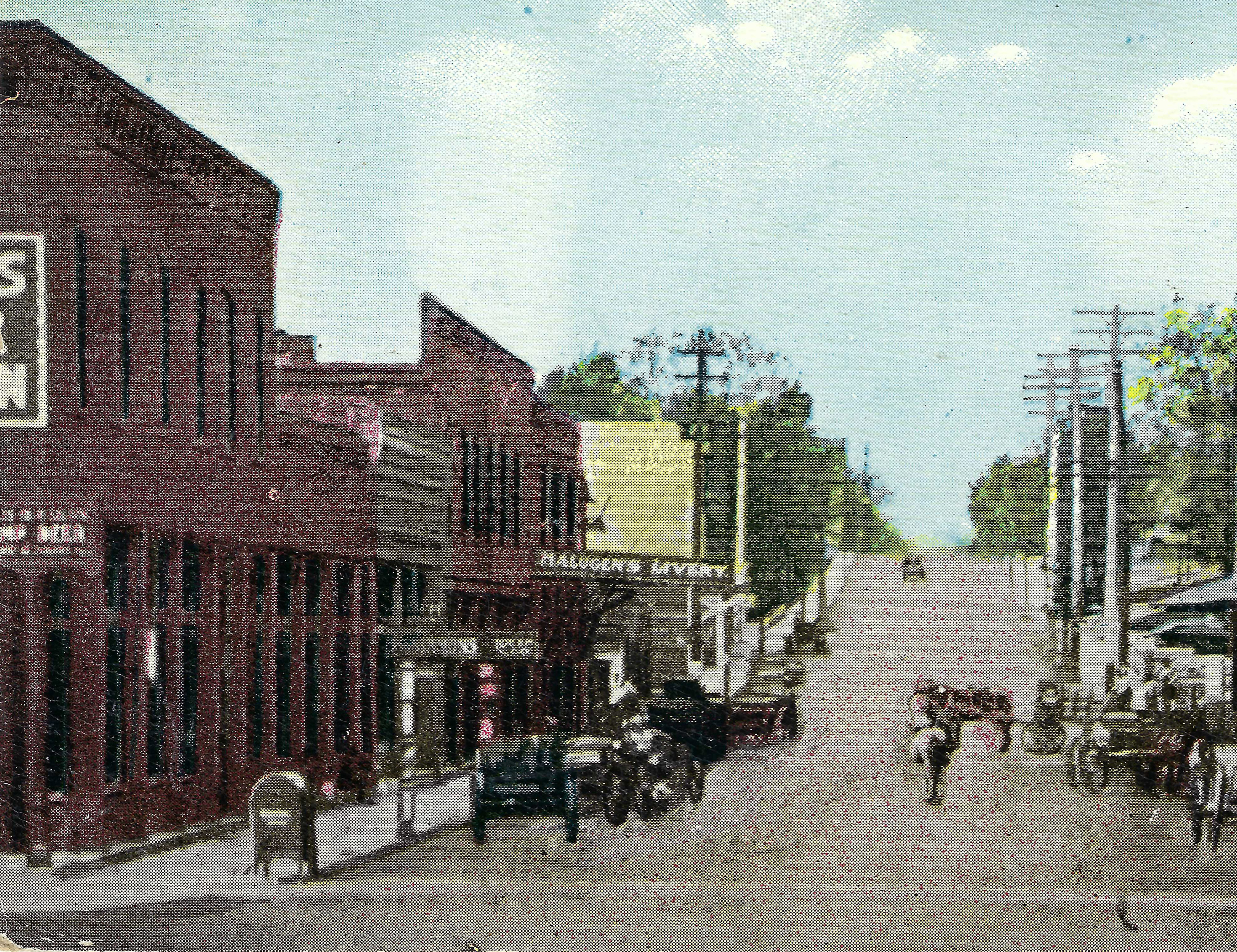
Hogg & Malugen Livery
412–400 Vine Street, Poplar Bluff, Missouri
Malugen Bros. Livery
418 Vine Street, Poplar Bluff, Missouri
Williams Brothers Garage
412–418 Vine Street, Poplar Bluff, Missouri
Garner Motor Co.
418 Vine Street, Poplar Bluff, Missouri
Faith's Business Equipment
416 Vine Street, Poplar Bluff, Missouri

Frisco Railroad Depot (Railroad Museum)
303 Moran Street
People in This Story
Related Businesses