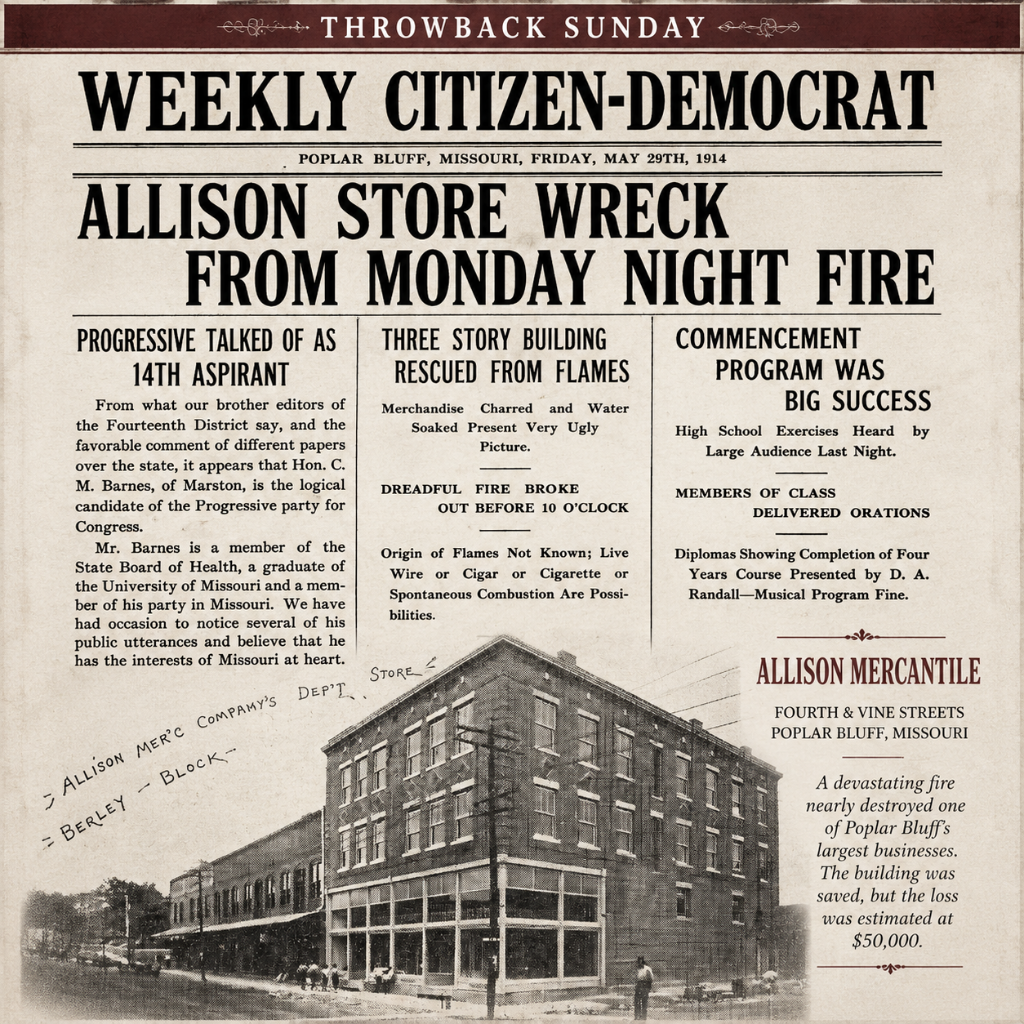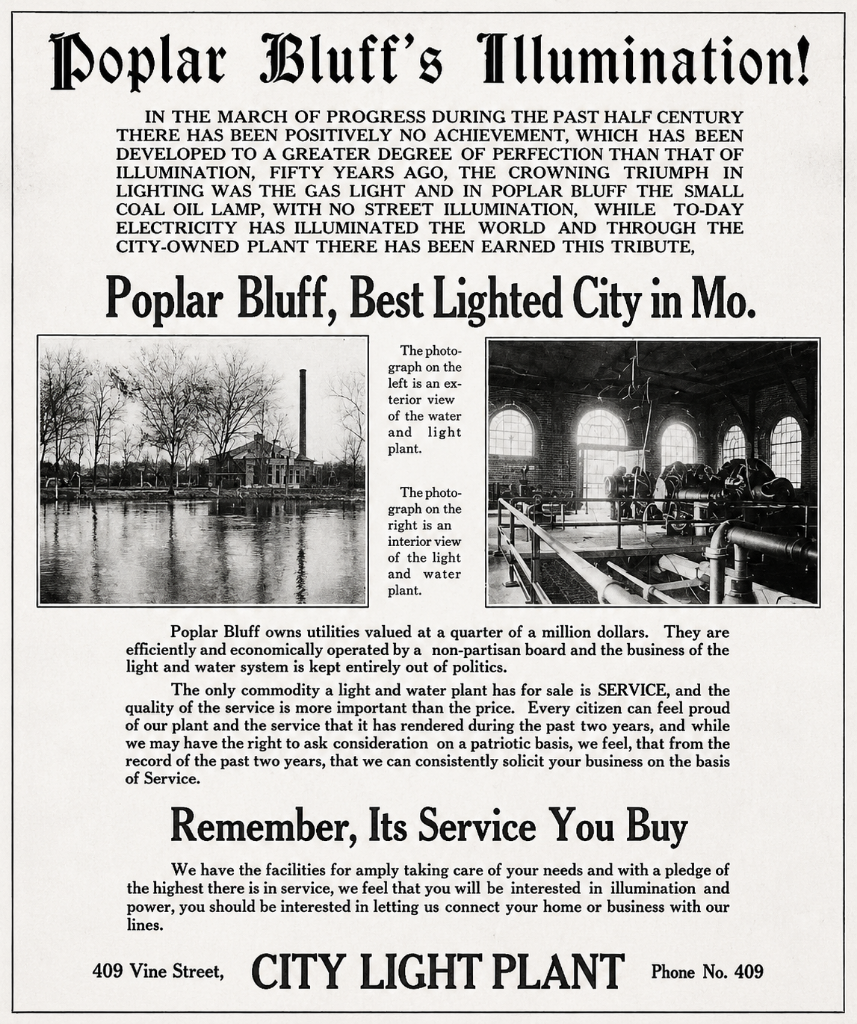

In December of 1898, the Poplar Bluff Republican published a special "Holiday Supplement" intended to showcase the city of Poplar Bluff and the opportunities found throughout Butler County. Reading the article today feels almost like stepping into the ambitions and optimism of a rapidly growing frontier town standing at the edge of a new century.
At the time, Poplar Bluff was reported to have a population of roughly 6,000 people, yet the newspaper confidently declared the city to be:
"Far Greater in Commercial Importance Than Its Population Would Indicate."
The article described Poplar Bluff as one of the principal railroad and trading centers of Southeast Missouri, emphasizing its location along the St. Louis, Iron Mountain & Southern Railroad and at the junction of the Cairo Branch. The newspaper explained that the city's importance reached far beyond its population because it served as a shipping and commercial center for a wide surrounding territory.
According to the article, the city enjoyed:
"Abundantly endowed with handsome residences, good streets and drives…"
while also benefiting from high ground and "taking its name from the bluffs upon which the town was laid out."
The tone throughout the piece is remarkably optimistic. The writers described Poplar Bluff as a community not only blessed by nature, but also determined to modernize and compete with larger cities across the region. They wrote that the city was:
"Beautiful by nature and the advantages so prodigally lavished by nature require but the reinforcement of moderate expenditures on the part of enterprising citizens to make Poplar Bluff one of the leading metropolitan cities of the middle South."
Education and religion were presented as important signs of civic stability and refinement. The article proudly noted that local educational institutions were "up to the highest standard of excellence," while churches and denominations of many backgrounds were represented throughout the city. In one particularly thoughtful passage, the newspaper stated that everyone could worship:
"According to the dictates of his conscience, without the fear of religious intolerance."
The article also painted a picture of a city rapidly improving its infrastructure and public services. Poplar Bluff's public institutions were described as "models of their type," and the newspaper specifically mentioned the Fraternal Opera House, electric light and power plant, waterworks, and hotels as evidence of a progressive and developing community.
One section proudly announced that:
"A complete sewer system is being projected."
while another noted that there were four school houses, and an additional building of more than $20,000 was nearing completion — a considerable amount for the era.
The city's business climate was also highlighted in great detail. The newspaper referred to Poplar Bluff's commercial leaders as:
"A class of enterprising and progressive gentlemen…"
and much of the supplement was devoted to showcasing local businesses, industries, hotels, stores, lumber companies, banks, and professional offices that helped shape everyday life in the city during the late 1890s.
The article even described shipping facilities as being "of the best," emphasizing the city's role as a transportation and trade center for Southeast Missouri. Railroads, commerce, agriculture, timber, and industry were all closely tied together in the vision of Poplar Bluff presented in the newspaper.
Perhaps most fascinating today is not simply the facts themselves, but the confidence and civic pride woven throughout the writing. The article reads less like a dry statistical report and more like a declaration that Poplar Bluff believed its best years were still ahead.
More than 125 years later, many of the buildings, businesses, and names mentioned in these pages have disappeared, while others survive only in photographs, postcards, and fading newspaper print. Yet the themes found in the article — growth, preservation, community pride, and belief in the future — still feel remarkably familiar.
Historic newspapers like this preserve more than dates and facts. They preserve the voice of a community and the way its citizens once saw themselves and their future.
If your family has old newspapers, photographs, postcards, or stories connected to early Poplar Bluff history, we would love to help preserve and share them for future generations.
Photos

The December 8, 1898 Holiday Supplement of the Poplar Bluff Republican, spotlighting the city's growth and commerce
Historic Poplar Bluff
Story Contributor
Source:
Poplar Bluff Republican
Related Business
These connections were automatically identified by AI from the story text and have not yet been verified. They may be inaccurate or incomplete. They are shown for research purposes and will be updated as they are reviewed by our archivists.
Possibly Connected Businesses
St. Louis, Iron Mountain & Southern RailroadUnverified
1910s
LLM identified as "Major railroad serving Poplar Bluff, cited as a key factor in the city's commercial importance" — "emphasizing its location along the St. Louis, Iron Mountain & Southern Railroad and at the junction of the Cairo Branch"
Poplar Bluff RepublicanUnverified
1890s
LLM identified as "Publisher of the 1898 Holiday Supplement that is the primary source for this story" — "In December of 1898, the Poplar Bluff Republican published a special "Holiday Supplement" intended to showcase the city of Poplar Bluff and the opportunities found throughout Butler County."